to your HTML Add class="sortable" to any table you'd like to make sortable Click on the headers to sort Thanks to many, many people for contributions and suggestions. Licenced as X11: http://www.kryogenix.org/code/browser/licence.html This basically means: do what you want with it. */ var stIsIE = /*@cc_on!@*/false; sorttable = { init: function() { // quit if this function has already been called if (arguments.callee.done) return; // flag this function so we don't do the same thing twice arguments.callee.done = true; // kill the timer if (_timer) clearInterval(_timer); if (!document.createElement || !document.getElementsByTagName) return; sorttable.DATE_RE = /^(\d\d?)[\/\.-](\d\d?)[\/\.-]((\d\d)?\d\d)$/; forEach(document.getElementsByTagName('table'), function(table) { if (table.className.search(/\bsortable\b/) != -1) { sorttable.makeSortable(table); } }); }, makeSortable: function(table) { if (table.getElementsByTagName('thead').length == 0) { // table doesn't have a tHead. Since it should have, create one and // put the first table row in it. the = document.createElement('thead'); the.appendChild(table.rows[0]); table.insertBefore(the,table.firstChild); } // Safari doesn't support table.tHead, sigh if (table.tHead == null) table.tHead = table.getElementsByTagName('thead')[0]; if (table.tHead.rows.length != 1) return; // can't cope with two header rows // Sorttable v1 put rows with a class of "sortbottom" at the bottom (as // "total" rows, for example). This is B&R, since what you're supposed // to do is put them in a tfoot. So, if there are sortbottom rows, // for backwards compatibility, move them to tfoot (creating it if needed). sortbottomrows = []; for (var i=0; i
Are you one of those people who have invested in an exercise machine? Sure, there are treadmills, home weight machines, stair-climbers, rowing machines, cross-country ski machines, and dozens of others, but do they give you the out-of-the-world workout you're truly looking for?
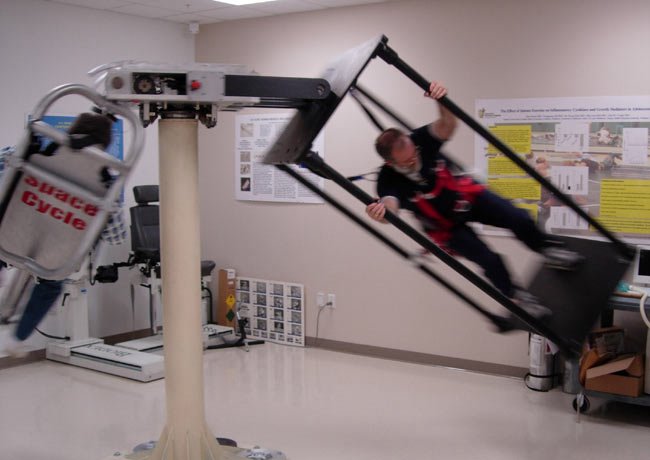
According to Space.com, researchers at the University of California-Irvine and the National Space Biomedical Research Institute (NSBRI) have invented a two-person centrifuge-style workout machine, the Space Cycle:
Imagine a two-person, hanging merry-go-round. A spinning wheel sits on top of a thick steel pole. On one side of the wheel hangs a recumbent bicycle. Opposite the bike is a cage-like platform. One person sits on the bicycle while the other stands on the platform.
As the bicycle rider pedals, the merry-go-round begins to spin, causing both the bicycle and the platform to spin around the pole. As the merry-go-round spins faster and faster, both the bicycle rider and the person on the platform begin to feel the effects of artificial gravity caused by the momentum of the device.
The person on the platform can now perform squat exercises at gravity equal or greater – the researchers have produced artificial gravity seven times that of Earth – to what they would experience on Earth.
While designed to combat the loss of bone and muscle tissue that comes from prolonged exposure in the low-gravity environment of space, I wouldn't be surprised at all to see a commercial version of this device show up in gyms across the U.S. The strength training possible in the hyper-gravity environment generated by the Space Cycle would be reason enough for athletic departments and professional sport teams to invest in the technology. In a world where competitive sports drive top athletes to seek every possible edge, there certainly would be a huge market for it.
Welcome to the blogosphere's toolchest! Here, unlike other blogs dedicated to analyzing current events, we create easy-to-use, simple tools to do the math related to them so you can get in on the action too! If you would like to learn more about these tools, or if you would like to contribute ideas to develop for this blog, please e-mail us at:
The S&P 500 at Your Fingertips
Mapping S&P 500 Performance, Since 1871
Should You Trade In Your Gas Guzzler?
What Are the Chances Your Marriage Will Last?
Reckoning the Odds of Recession
Your 2009 Paycheck
Tipping Around the World
Revisiting the Lottery
Estimating Your Life Expectancy
Connecting the Dots for Personal Income Taxes
First Time Visitor to Political Calculations?
On the Moneyed Midways
A Lot, But Not All, of Our Tools
Political Calculations' Recession Probability Track shows the probability that the U.S. economy will be in recession 12 months from the indicated date (shown in red) while revealing the probability trend over the past four years.
Previously, the probability of recession peaked at 50% on 4 April 2007, which means that March-April 2008 was the most likely period in which the NBER would have found the U.S. to be in recession.
As it happens, they almost did. The NBER instead chose December 2007 as the beginning month of the most recent recession (we had found a 46% probability for a recession beginning in that month!)
Political Calculations is also the online home of On the Moneyed Midways (aka OMM), a review of the best posts contributed to the week's best business and money-related blog carnivals. More than that, we also name one post in each edition as being The Best Post of the Week, Anywhere! and at the end of each year, we name The Best Post of the Year, Anywhere! as well as identifying the best blogs we found during the course of the year!
The link below will take you to the running index containing our most recent back issues (you can easily navigate the index to find older editions.)
This site is primarily powered by:
Visitors since December 6, 2004:
The tools on this site are built using JavaScript. If you would like to learn more, one of the best free resources on the web is available at W3Schools.com.
ZunZun - Exceptional regression analysis tool.
Wolfram Integrator - Solve integrals. Do calculus!
Create a Graph - Easy-to-use basic graph-making tool.
Many Eyes - Data visualization extraordinaire!