What is wrong with the Oscars?
If we were really going to answer that question, we would need a much bigger blog, but if we were to focus on the televised history of the annual Academy of Motion Picture Arts and Sciences Awards ceremony, we would point to the sheer tediousness of the production.
All the creative talent available to Hollywood, and somehow, when they celebrate themselves and their achievements in the past year, they manage to make it into a boring train wreck. Every year. And they know it.
This year, the writers at the Wall Street Journal forced themselves to watch over 18 hours worth of the Academy Awards ceremony, much of it from last year, where they identified several aspects of the low-rated televised ceremony that just drag on and on for viewers, and found one in particular that stood out.
Last year’s Oscars show was the longest telecast in years, and also the lowest-rated one ever. Coincidence? Doubtful.
Such long nights—last year’s ran nearly four hours—help explain why the length of this year’s show is one of Hollywood’s biggest preoccupations.Amid this awards-season angst, The Wall Street Journal set out to calculate precisely why the Oscars are so long. In the amount of time we spent viewing Oscar shows from 2014 to 2018, logging the number of minutes eaten up by speeches, songs, crowd shots and other staples of the annual broadcast, we could have plowed through the entire “Godfather” trilogy. Twice.
Which activities take up the most time? One of the most surprising revelations: Walking. Viewers watch an average 24 minutes of celebrities and winners walking to and from the stage. The figure is made primarily of victors ambling up to receive awards, as well as the generally quicker strides of presenters strolling to the microphone and guests heading offstage. This year, the academy is trying to curtail the walking shots, which can include cutaways of clapping celebrities, by urging winners to move more quickly.
Short of using a time delay and then speeding through ceremony's many time-filling Roger Corman-esque walking scenes the way the Keystone Kops were featured in films over a hundred years ago, which admittedly would be more entertaining, especially if they brought the Keystone Kops back to accelerate the action, it's not going to work. There's just too much else that's wrong and makes the ceremony unbearably long. Not having a capable host is going to hurt, to name just one new problem the Oscars will have this year.
They really owe an apology to Kevin Hart.
Previously on Political Calculations
- Better Movies Than The Best Picture
- The Dismal Oscars and How China Can Make Hollywood Make Better Movies
- Deadpool Versus the 2015 Best Picture Nominees 2
- Deadpool Versus the 2015 Best Picture Nominees
- The Value of Winning the Oscar for Best Picture Versus Not Winning
- The Difference Between Being Pro-American and Anti-American at the U.S. Box Office
- Copyright Math and the U.S. Entertainment Industry
- The "Hit" Equation for Box Office Gold?
- Can Billy Crystal Sell Movie Tickets?
- Anti-US Fervor in Hollywood
- The Anti-War on Hollywood's Box Office
- Reflections on the Oscars and the Most Manipulative Man in Hollywood
- How Men Are Like Bad Movies, and Why Bad Movies Keep Getting Made
- Do Academy Awards Boost Box Office?
- Does Best Picture Equal Big Box Office?
Labels: academy awards


With the 90th Academy Awards set to be broadcast this weekend, movie lovers around the world are bracing for yet another poorly written, inappropriately political and excessively pretentious four-or-more hour long commercial for the film that will be crowned with the title of being named the Academy of Motion Picture Arts and Sciences' "Best Picture" in 2018.
But what if the members of the Academy of Motion Picture Arts and Sciences get it wrong?
Let's face some hard facts. These arty types have completely blown it in years past, where dare we say that every other movie nominated for the Academy's top award in some years was better than the motion picture that actually won.
And we can prove it! Starting with Business Insider's ranking of the worst-to-best movies that won "Best Picture" (or "Outstanding Production" as it was called in the Academy's earliest days), which they based on the combined score of Rotten Tomatoes' critics and audience scores for each Best Picture winner, we went the extra mile to see how the other, non-winning nominees for Best Picture fared by the same ranking system compared to the film that won in the same year.
What we found is that for the five worst ranked Best Picture winners, all the same-year competing nominees outscored the movie that won the Oscar. We've presented our results in the following table, where whenever possible, we've not only identified the movie that *should* have won the Oscar in each of these years, we've also linked to where you can watch the movies on Amazon Prime to see for yourself. Because if we're being honest, that will probably be a more rewarding experience that watching this year's Academy Awards ceremony.
| Better Movies than the Academy Awards' "Best Picture" | |||
|---|---|---|---|
| Rank | Oscar Year | Best Picture Winner (Rotten Tomatoes' Critics Score/Audience Score) | Better Alternatives (Also Nominated for Best Picture, But Inexplicably Lost) |
| The Worst Ever | 1930 | The Broadway Melody (35%/21%) | In Old Arizona (56%/40%) Alibi (43%/43%) The Patriot (Unreviewed/57%) Hollywood Revue (40%/17%) |
| 2nd Worst Ever | 1953 | The Greatest Show on Earth (44%/55%) | High Noon (96%/89%) The Quiet Man (90%/91%) Moulin Rouge (75%/90%) Ivanhoe (79%/65%) |
| 3rd Worst Ever | 1932 | Cimarron (53%/25%) | The Front Page (92%/64%) Skippy (100%/54%) Trader Horn (100%/33%) East Lynne (Unreviewed/Unreviewed) |
| 4th Worst Ever | 1985 | Out of Africa (57%/83%) | The Color Purple (88%/94%) Witness (92%/80%) Kiss of the Spider Woman (88%/81%) Prizzi's Honor (88%/62%) |
| 5th Worst Ever | 1934 | Cavalcade (61%/26%) | I Am a Fugitive from a Chain Gang (100%/91%) Lady for a Day (100%/79%) The Private Life of Henry VIII (100%/74%) Little Women (92%/77%) 42nd Street (95%/65%) A Farewell to Arms (92%/52%) She Done Him Wrong (90%/53%) Smilin' Through (Unreviewed/81%) State Fair (Unreviewed/60%) |
Aside from the really depressing realization of how many of these movie titles have been remade over the years, it's really quite stunning to discover just how bad that some of Hollywood's "Best Pictures" have been. Especially when compared to how good the "losing" nominated films of the same year have proven to be.
And yet, no matter how bad they were, they're still better to watch than the Academy Awards broadcast from any year!
Update: Via RealClearLife, Oscar Winner May Not Really Be Best Picture - you may be surprised at how deep the list of disappointing winners goes, and also by how much it extends into the present!
Previously on Political Calculations
- The Dismal Oscars and How China Can Make Hollywood Make Better Movies
- Deadpool Versus the 2015 Best Picture Nominees 2
- Deadpool Versus the 2015 Best Picture Nominees
- The Value of Winning the Oscar for Best Picture Versus Not Winning
- The Difference Between Being Pro-American and Anti-American at the U.S. Box Office
- Copyright Math and the U.S. Entertainment Industry
- The "Hit" Equation for Box Office Gold?
- Can Billy Crystal Sell Movie Tickets?
- Anti-US Fervor in Hollywood
- The Anti-War on Hollywood's Box Office
- Reflections on the Oscars and the Most Manipulative Man in Hollywood
- How Men Are Like Bad Movies, and Why Bad Movies Keep Getting Made
- Do Academy Awards Boost Box Office?
- Does Best Picture Equal Big Box Office?
Labels: academy awards
The production team behind the Blade Runner 2049 movie opening in theaters today had a lot of creative energy to spare. So much so that they put together three shorts to explain what major events happened from the end of the original Blade Runner, which was set in the Los Angeles of 2019, and the beginning of the new motion picture.
The first short, at least in chronological order if not the order the shorts were released, features the animation work of Shinichiro Watanabe, who is perhaps best known for the Cowboy Bebop anime series, starts the ball rolling for what happened to Los Angeles - Blade Runner Black Out 2022:
The second short features Jared Leto's character, Niander Wallace, whose company was allowed to produce new replicants after a decade of prohibition - Blade Runner 2036: Nexus Dawn: The third short follows Dave Battista's character, Sapper Morton, whose actions set the immediate stage for what happens in the new movie - Blade Runner 2048: Nowhere to Run: Where was this movie all summer long?
Labels: academy awards, movies
Summer 2017 is turning out to be something of a disappointment at the cineplex. So, with that thought in mind, we're going to do what millions of teens this summer are doing and turning to YouTube for the kind of fun that used to come with Hollywood's biggest blockbusters, but which seems to be in too short of supply this summer. Enjoy!...
But wait, we have a double feature!
In other, important entertainment news, Hollywood director Joel Schumacher has finally apologized for Batman and Robin, which almost completely counteracted all that was good at the movies in the summer of 1997.
Labels: academy awards

We made it another year without having to suffer through watching the annual abomination that is the Academy Awards ceremony this past Sunday, where Moonlight was declared to be 2016's Best Picture after La La Land was.
The blame for the Best Picture snafu apparently lay with Hollywood's accountants, who had broken away from their regular work and also their regular Sunday-night game of Three Card Monte to hand out cards in sealed envelopes identifying this year's "winners" to people who are professionally trained to read whatever words are put in front of them while on stage. So it couldn't possibly have been the Academy Awards' producers fault, because who could possibly have foreseen that such a thing could happen during a live televised broadcast? Especially after those four other times....
That wasn't even the day's only disaster. Earlier, a "giant prop" used as part of a background set for a performance number at this year's Academy Awards crashed down onto the stage, ripping a large curtain and crushing a camera during a break in the event's rehearsals. So far, nobody has fingered the Hollywood accountants as also being behind that incident, but fortunately, at least no one was injured.
And then, there was the untimely premature death announcment for Australian movie producer Jan Chapman, which came in the form of her photograph appearing during the Oscar's "In Memoriam" segment, where she had been misidentified as Australian costume designer Janet Patterson, who sadly did pass away back in October 2015. The auditors from PriceWaterhouseCooper couldn't be reached for comment regarding their potential involvement in that mix up.
These three incidents demonstrating exceptionally poor quality control on the part of the producers of the 89th Annual Academy Awards were in *addition* to all the mundane things that make the annual Academy Awards televised broadcast such an awful viewing experience year after year, most of which are actually planned to happen. We knew better than to watch it before the broadcast began, but considering what happened, we're even more against the idea of investing any amount of time to watch future Academy Award presentations.
If this were baseball, what happened at the 89th Academy Awards would be strikes one, two and three against Hollywood's producers. If we were looking to invest money to make either money or art by making motion pictures, we would rank the idea of doing that behind the opportunity to buy Turkish bonds at ground floor prices.
Speaking of which, what kind of people actually invest money to make movies these days?
Increasingly, the generic answer to that question in recent years has been "Chinese investors", where a lot of money has been cashed out of China's economy to fund both movie productions and the acquisitions of Hollywood movie studios. In return for that largesse, Hollywood's producers have become especially accommodating to Chinese interests.
These deals have sparked concern over whether China’s expanding influence in Hollywood could lead to more pro-Chinese propaganda in U.S. films. The Chinese government tightly controls media content, and Hollywood studios have been known to alter films to feature China or the Chinese government in a more flattering light to gain access to the country’s lucrative film market.
If you were to go out into today's movie theatres to see the result of that influence, you would need to look no further than The Great Wall starring Matt Damon, which may be considered to be a prime example of the intersection of Hollywood movies that were purposefully made to satisfy the Chinese government's sensibilities. The good news, if you can call it that, is that despite its bad reviews, it is reportedly much more watchable than the annual Academy Awards ceremony.
While the movie did alright financially in China, it got bad reviews in that country, even though it was crafted specifically for it. Meanwhile, two weeks into its run, it's clear that it won't be making much money from American audiences.
Hollywood is in desperate need of a turnaround artist to fix its multitude of problems. But can its current predicament, where poor quality defines its intended blockbuster products and absolutely permeates the televised award show where it purports to recognize the best work done within the motion picture industry, even be fixed at this point?
Believe it or not, the answer may lie with the Chinese government, who in its desire to halt the flight of capital from that country, is cracking down on Chinese businessmen to keep them from making "irrational" overseas investments in Hollywood film productions, among other unseemly investments, where they suspect that the investments are merely a means for moving large sums of money outside of the government's control.
Responding to the still-hypothetical question asked by Hollywood Reporter in response to that developing crack down, "What if China's money stream stops flowing to Hollywood?", Ed Driscoll speculated that the end of that flow of cash into Hollywood's odd accounting system might actually lead to better quality movies:
Movies might suck less, for one thing, since their plots and dialogue are often dumbed for foreign consumption — not to mention censored as well to placate the Chinese government. Or as even urban haute bourgeois* left Vanity Fair asked in August, "Did You Catch All the Ways Hollywood Pandered to China This Year?"
But would Hollywood movies not made to specifically pass muster with China's government do more poorly at the box office in that country?
There is an interesting example from the biggest money-making movie of 2016: Captain America: Civil War, which not only dominated the U.S. box office, it dominated box offices around the world, including in China.
Better still, it drew strongly positive reviews that praised the movie's intelligence:
Critics Consensus: Captain America: Civil War begins the next wave of Marvel movies with an action-packed superhero blockbuster boasting a decidedly non-cartoonish plot and the courage to explore thought-provoking themes.
If you go down the list of 2016's top money making films, you'll find similar global box office results and critical summaries for movies like Finding Dory, Zootopia and The Jungle Book, which all earned considerably more money overseas than they did in the United States while they were also critically praised for their thoughtful qualities.
The only exception in the Top 5 grossing moving of 2016 is Rogue One: A Star Wars Story, which wasn't cited for many thoughtful qualities by critics. And in fact, Rogue One was the only movie in the year's Top 30 that made more money in the U.S. than it did overseas.
Dumbing down a movie script to make it more appealing to another country's cinematic censors is the wrong way to go if Hollywood producers are really in the business of making entertaining or thought-provoking movies that make money. All things considered after this year's multiple Academy Awards fiascos however, we wonder if Hollywood's producers should even be considered to be part of the entertainment industry. If we had to guess, we would think that they're really in some form of organized crime, because that makes more sense than the accounting system they use.
Labels: academy awards
In our final post of 2016, in which we reviewed the biggest math-related stories of that year, and in particular, a story about the first statistically significant demonstration of Zipf's Law, we discussed why the story was important to the development of artificial intelligences (AIs):
While not much more than an interesting finding now, that Zipf's Law appears to hold across such a large body of human language will have applications in the development of artificial intelligence, particularly for machine understanding of human language. That next generation Amazon Echo, Google Home, or whatever mobile voice recognition app will be on your mobile devices in the future will get better at understanding and communicating with you as a result. More practically, because technology will be better able to replicate the patterns inherent in human writing, movie producers have moved one step closer to realizing their long-held dream of being able to replace all those annoying and costly human screenwriters with automated script writers, where audiences won't be able to tell the difference for most Hollywood productions.
That day is closer than you think, as an experiment between two AIs named Vladimir and Estragon, who happen to have been manufactured by Google, appear to have fallen in love. As you can see in the following video clip, the dialogue between the two Google Home units is approaching the emotional depth of what might pass muster as the script for a sequel to a recent blockbuster romance.
According to Core77, they have also discussed tacos, where with additional technological development, it wouldn't be hard to anticipate that dialogue worthy of Nora Ephron cannot be far behind.
At the very least, that's something to think about now that we're well into the entertainment industry's award season. The world of the future will be far stranger than most people alive today appreciate!
Labels: academy awards, technology
Several weeks ago, we compared the box office performance of the movie Deadpool against its eight 2015 Best Picture Academy Award-nominated peers. Back then, we found that the scrappy Deadpool beat all eight films through its first week of release.
Today, we're producing the sequel to that original story, where this time, we find that the eight Best Picture nominees of 2015 have struck back, taking the cumulative box office crown away from 2016's Deadpool.

It really shouldn't be a surprise, but you should always expect that eight movies, even 2015's Best Picture nominees, will combine to make more money at the box office than just one movie.
The real story here is how the eight 2015 Best Picture nominees did it. Basically, they added another 8,400 theaters in their third week of release to their previous week's total of 10,487, dwarfing the peak of 3,836 for Deadpool by nearly a factor of 5.
And then, in their fourth week of release, they added another 566.
It was like one of those cliché fight scenes in a superhero movie where the evil league of supervillains start fighting really dirty by ordering their henchmen to "sic 'em" in the hopes of overwhelming their greatly outnumbered foe.
But what if the odds were equalized? What if we calculated the average gross per theater for each day of release for all these movies, and then compared their box office prowess, mano a mano?
Here's the chart showing the results of that daily calculation for the first four weeks of release for Deadpool and the eight 2015 Best Picture nominees.

And here's how it looks when we add up the cumulative average box office per theater take.
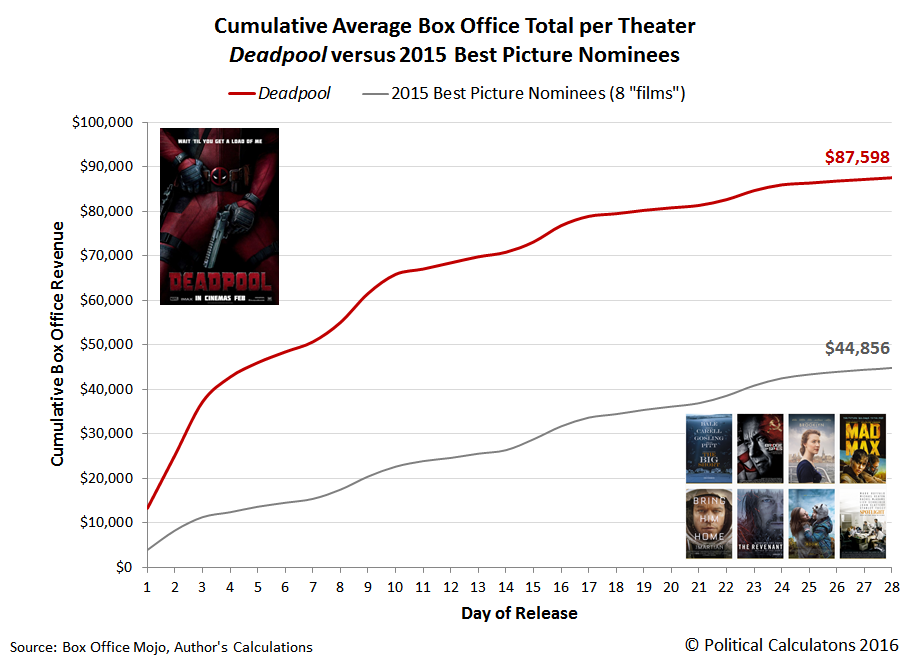
In this last chart, we confirm that Deadpool is nearly twice the movie that the eight Best Picture nominees of 2015 are where performance in Hollywood matters most. At the box office.
But here's the best part - the winner of the Academy Award for Best Picture and Pretentiousness in 2015, Spotlight, is going to have a sequel. So at some point in the future, we're going to get a rematch. Alas, without The Revenant 2.
Just like in the movies!
Labels: academy awards, business, movies
It's time for the Academy Awards once again, which our longtime readers know fills us with an overwhelming sense of imminent doom.
What would it take to make watching the annual awards ceremony into a more tolerable experience?
We're serious. What would it take? Because the producers and writers for the awards show certainly don't have any good ideas, and try as we might, there just is not enough beer in the world to make it better....
But then, we suddenly and unexpectedly found reason for hope, when the answer became apparent thanks to Ryan Reynolds' last minute Oscars campaign to get Deadpool nominated for Best Picture.
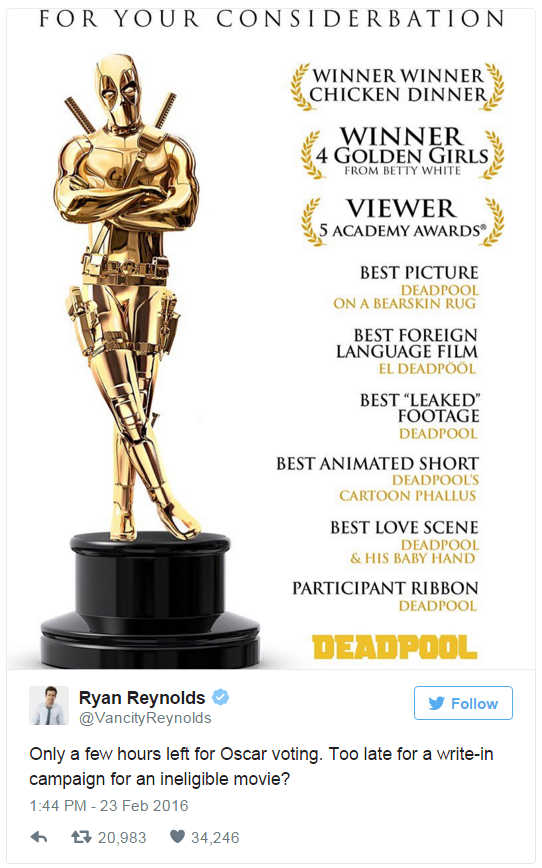
Although technically ineligible for consideration by the temporally-constrained members of the Academy of Motion Picture Arts and Sciences, who limited the nominees to just those films shown in U.S. theaters in 2015, it's exactly what the Academy needs to really shake things up. Otherwise, we'd be stuck with a bunch of not-so-popular films of questionable watchability that were nominated purely on the basis of their artistic merit.
If you're like us, your gag reflex was triggered when you read the last two words of that previous sentence.
That's because you, like us, know that Hollywood only really cares about two things: money and status. Hollywood people absolutely obsess over both things, where success is defined as either making lots of bucks at the box office or by achieving status through the recognition of their artistic achievements by their peers.
They use Oscars to measure their status as "artists", where the biggest winner gets the Oscar for Best Picture. In making that determination, voting members of the Academy will go off to a dark room, whip out their complimentary viewing copies of the nominated films, and then compare them to each other over and over again until they've ranked one above all others. The winner is then awarded with the peer recognition of their artistic status in the form of a 13.5-inch tall gold-plated phallic trophy.
Really. It's just like that.
That's why upsetting all the Academy's apple carts by getting a more popular movie like Deadpool into consideration for Best Picture of 2015 is such an attractive idea, and all the more so because Deadpool so clearly captures the vital essence of what drives Hollywood itself.
And by the other measure of success in Hollywood, money, Deadpool has already beaten all the contenders for Best Picture of 2015. At least, through its first full week of release:

And that's without taking into account the fact that the eight Best Picture nominees were being shown in nearly three times as many theaters as Deadpool. If we were to do that math, the cumulative box office performance of the 8 Best Picture nominees would, shall we say, come up somewhat short.
Which is why Hollywood is talking about Deadpool 2 and not The Revenant 2. Unless perhaps the producers of that other sequel fix the main deficiency of the first one.
Labels: academy awards
When the first trailer for Star Wars: Episode VII came out, a new star was born that stood out from everyone else in it. You know who we mean:
It was the droid BB-8, who also stole the show when rolling out onto the stage at Star Wars Celebration Anaheim:
But wait! Did you know you could hack your own BB-8 style droid together from a Sphero and some magnets?
Industrial designer Christian Poulsen provides step-by-step directions. But if that's beyond your personal level of technical competence, you could just wait for Sphero to come out with an officially licensed version at some time in the future....
Labels: academy awards, technology
Aren't Hollywood actors supposed to be among the most ardent supporters of left wing causes?
And as members of organized labor unions going back for decades, aren't Hollywood actors supposed to be looking out for the interests of those among their ranks who are clearly being exploited for their talent for precious little pay?
So you would think that such ardent supporters of left wing causes and union members would stand in solidarity with their fellow actors to prevent them from having their talent exploited for precious little pay. But you would be wrong, because these same people also believe that hiking the minimum wage will not cost them their jobs, but could potentially shut down the theaters where they work.
An impassioned, two-hour, open-mike meeting about the future of Los Angeles County's small-theater community Saturday at the Renberg Theatre at the Los Angeles LGBT Center in Hollywood drew an overflow crowd of well over 200 theater folks.
With just one exception, the dozens of speakers, including a calmly emphatic Tim Robbins, were motivated by a deep fear of what a proposed higher wage might do to their artistic scene.
Actors' Equity, the national union for stage actors, is seriously considering imposing a $9 hourly minimum wage for its members when they perform or rehearse in L.A.'s small venues.
Robbins and the rest think $9 an hour is exorbitant and that actors should continue working on small stages for what they have been receiving for decades. The going rate is $7 to $15 per performance, depending on ticket prices and seating capacities. Rehearsals, which can consume scores of hours, pay nothing.
Most of the small theaters are nonprofit organizations that need donations to augment ticket sales in order to sustain what's typically a hand-to-mouth existence.
Robbins is the founder and artistic director of the Actors' Gang in Culver City, launched before his 1988 ascent to movie stardom in "Bull Durham."
He stepped to a microphone wearing a pale blue denim jacket and said it made no sense for union officers to expect small theaters to survive under the proposed new terms.
We predict that many of the same actors will soon be calling for new government-funded support for the arts. But then, the government has been funding the arts for decades through government entities like the National Endowment for the Arts, so its kind of difficult to see how that would be anything more than another poorly targeted welfare program. Especially since the NEA has never funded any work that might be considered to be a significant artistic achievement.
Don't believe us? Try to name one work they've funded from the last fifty years that greatly influenced the direction of any form of art in the United States off the top of your head, without turning to Google's search engine to try to dig one up. Then turn to Google and see what stands out to you as the most influential work funded by the National Endowment for the Arts that would be instantly appreciated as such by regular Americans.
Like any bureaucracy that really only looks out for its cronies, they've mainly done mostly wasteful things that, when they have succeeded in drawing an audience of the public, was usually the result of a controversy it needlessly provoked, mainly as a device to attract a public audience in the first place.
But no work of any enduring artistic impact. That's because the artists funded by these government programs neither needed the support of the community nor of commercial audiences. And it shows, because to have an enduring impact, they would have to connect with both.
That's what makes these "exploitative" small theater groups so important and worth preserving. To survive, they have to connect with their audiences and with the communities in which they operate. That's a cauldron that develops the kind of artistic development and subsequent achievement that can stand the test of time.
But that's also a kind of competition that those who are connected with the "right" people on the left don't want to face. Which is why, after so many decades, they're out to close it down. Never mind that everyone who participates in those theater groups volunteers to do it because of how they develop their artistic potential and because of the opportunities they provide to perform.
Even if it means doing two shows a day for $7 to $15 a performance and rehearsing for free!
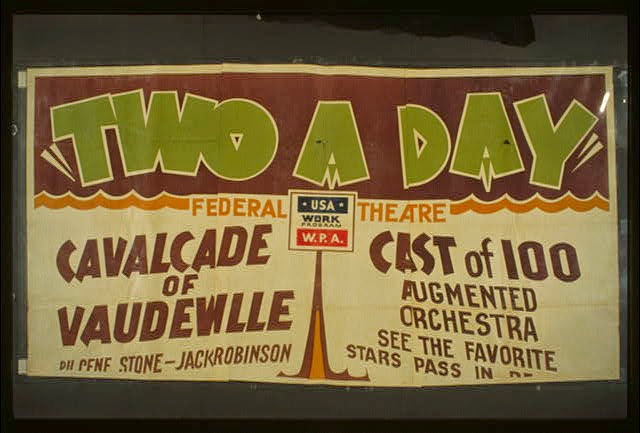
HT: Mish, who gave us the angle we needed to inspire us to talk about the motion picture business this eyar after we were so sorely disappointed by the reports of how lame the 2015's Academy Awards ceremony was. [Message to the Academy: Joan Rivers was the only one who made watching any portion of the "ceremonies" tolerable - it was a big, bad mistake to snub her among the posthumous recognitions!]
Labels: academy awards, minimum wage
Maybe not as good as the alternate ending for Gravity, but not bad either....
Have a great weekend!
Labels: academy awards, none really
A lot of how we, as human beings, perceive the world around us has a lot to do with the tone and mood with which information is communicated to us. Mr. Scott of Hughes Academy in Charleston, South Carolina explains:
Tone and mood both deal with the emotions centered around a piece of writing. Though they seem similar and can in fact be related causally, they are in fact quite different.
Tone is the author’s attitude toward a subject. While journalistic writing theoretically has a tone of distance and objectivity, all other writing can have various tones.
If we were to read a description of a first date that included words and phrases like “dreaded” and “my buddies forced me to go on the date”, we could assume that the individual didn’t really enjoy the date....
Mood is the atmosphere of a piece of writing; it’s the emotions a selection arouses in a reader.
Of course, the application of mood and tone extends far beyond the written word - we see it in all forms of communication. As a basic example, consider the tone and mood established in the trailer for the movie Gravity:
Now consider how differently the audience would perceive the movie if the following alternate scenes, lasting a total of one minute and twelve seconds, had not been cut from the film because of the differences they present in the mood and tone for the story the film's director wanted to tell:
And that's one reason why so many people rightfully believe that literary authors and film directors are total jerks.
Labels: academy awards, none really
How much does winning the Academy Award for Best Picture matter for DVD sales?
If you think about it, the annual televised Oscars ceremony is really little more than a four-hour-or-more-long commercial for the DVD of the movie that "wins" the "Best Picture" category. But we wondered how much that really matters for the movies' DVD sales.
To find out, we need to compare the DVD sales of a "Best Picture" winner with the DVD sales of a "Best Picture" nominee during the first several weeks after they go on sale to the public - ideally with the Oscars telecast occurring within just a few weeks of their DVD release. And really ideally, Best Picture contenders that have nearly identical sales during those first weeks of their release, except perhaps for the weeks immediately following the Oscars telecast.
We found two great examples from the 85th Academy Awards, which were televised on 24 February 2013: the movies Flight, whose DVD sales began two weeks before the 24 February 2013 Academy Awards telecast, and Argo, whose DVD sales began just one week before the Oscars telecast. Check out what we found in the chart below, in which we've also showed the DVD sales for a popular movie directed by Seth MacFarlane, who hosted the 85th Academy Awards telecast, just for comparison purposes:

In this chart, we see that the weekly DVD sales for both Flight and Argo are virtually identical for every week of their release except for one - the second week of DVD sales for Argo were double those of Flight, corresponding to the week immediately after it won the Academy Award for Best Picture of 2012.
For Argo, that meant that winning the Best Picture Oscar equated to an extra 142,665 more sales than it would have had that week if it hadn't won the Oscar. And at an average sales price of $14.97 that week, Argo's DVD sales grossed an additional $2,135,546 more than it likely would have for the movie's makers and distributors.
Notice also that there's almost no difference between Flight's and Argo's weekly DVD sales for all the other weeks of their DVD sales - their numbers are only meaningfully different for the week following when Argo won for Best Picture.
That makes the Academy Awards a four-hour-or-more-long commercial whose advertising impact on DVD sales only lasts for about a week. And it's only effective for the winner of the Best Picture Oscar, because Best Picture nominee Flight didn't see any meaningful bump in its corresponding third week DVD sales, which came right after the Oscars telecast.
But if nothing else, we hope our chart explains why Hollywood is now busy making Ted 2. Without good movies featuring talking bears like the original Ted, they just wouldn't be able to afford to make as nearly as many critical "successes" otherwise!
Previously on Political Calculations
- The Value of Winning the Oscar for Best Picture Versus Not Winning
- The Difference Between Being Pro-American and Anti-American at the U.S. Box Office
- Copyright Math and the U.S. Entertainment Industry
- The "Hit" Equation for Box Office Gold?
- Can Billy Crystal Sell Movie Tickets?
- Identity of Political Calculations' "Ironman" Revealed
- Anti-US Fervor in Hollywood
- The Anti-War on Hollywood's Box Office
- Reflections on the Oscars and the Most Manipulative Man in Hollywood
- How Men Are Like Bad Movies, and Why Bad Movies Keep Getting Made
- Do Academy Awards Boost Box Office?
- Does Best Picture Equal Big Box Office?
Labels: academy awards, business
 It's not often that we can measure something like pro or anti-American political bias in American movies, but we can today because of a unique experiment conducted by Hollywood!
The reason why is because of the uneven level of quality of most movies, which can make it extremely difficult to make direct comparisons of a characteristic like political bias between them using the measure of how well they do at the box office. For example, one movie in a given genre might have good acting, but suffers from bad writing or poor direction. Another movie might have only okay acting and direction, but features really good writing.
That's often because different movies get made by different people, which introduces a lot of random elements into their production that can affect their quality, which in turn, affects their money-making potential. And then there's the matter of what audience the movie is aimed at - a movie targeted for teens will have a different box office performance than a movie targeted toward a older segment of the movie-going public.
But what happens when you put the same creative team to work behind movies that target the same basic audience demographic in the U.S., but are very different in their pro or anti-American political sentiment?
What happens is that you take out a lot of the randomness that might otherwise make a comparison between the movies produced by the same team invalid. You get a consistency of quality in all the other elements that can affect box office performance that makes it possible to measure just how much having a pro or anti-American political bias can have at the U.S. box office.
And that's exactly what we have today, thanks to the former Academy Award for Best-Picture winning The Hurt Locker and the current Academy Award Best-Picture nominee Zero Dark Thirty!
Both movies were made by same production team, including the director and screenwriter. Although they feature different actors, the overall quality of acting in The Hurt Locker and Zero Dark Thirty is also consistent, as measured by Academy Award nominations for the lead characters in each film.
Where they differ is in their political bias in how they present their stories, in which the post 9/11 U.S. war against terror is the backdrop. The Hurt Locker suggests that U.S. military servicemen conducting operations against terrorists are psychologically-impaired, irresponsible rogue elements who are dangers to themselves and others. Zero Dark Thirty portrays American spies and secret military operatives as devoted avengers of a horrific act of terror against the United States.
Same quality-level movie, made by the most of the same people, different political bias. Our chart below shows the cumulative U.S. box office receipts as reported by Box Office Mojo for both The Hurt Locker and Zero Dark Thirty against the number of days since release in their original theater runs. We also show the inflation-adjusted box office for The Hurt Locker in terms of constant 2012 U.S. dollars:

Through their first 65 days of release, Zero Dark Thirty has made over seven times as much in U.S. box office receipts as did The Hurt Locker, with nearly $90 million in receipts just in the United States. That figure then represents the real difference between being pro and anti-American at the U.S. box office.
As for why Hollywood keeps making anti-American movies even though it would appear to cost them so much at the U.S. box office, well, when it comes to America, it seems they have other values....
Labels: academy awards, box office, business, politics
Can anyone trust the U.S. entertainment industry to be honest with the business numbers they make public?
We've all heard of Hollywood's accounting frauds, where even those small movies with tiny production budgets that unexpectedly go on to become huge blockbusters making millions and millions of dollars at the box office somehow never generate a profit.
But what about the other things the moguls of the entertainment industry say about their business? Things like the number of jobs and the amount of money they say are lost every year in their industry because of the damage done by copyright piracy?
Rob Reid takes on the entertainment industry's "©opyright Math™" in the following TED presentation (HT: Barry Ritholtz):
Some quick notes:
- The diameter of a penny is 0.750 inches (19.05 mm). It takes a lot of pennies to get to Mars!
- If Hollywood and the music industry are hurting in their pocketbooks from copyright piracy, it isn't showing up in the amount of GDP they generate in the U.S. every year. See the Congressional Research Service report below....
- Nor does it seem to be affecting the government's count of the number of people who work in the motion picture and sound recording industry in the U.S. each year in any meaningful way.
All in all, it appears that the answer to the question we asked at the beginning of this article is simply "No."
Labels: academy awards
A team of Japanese physicists and mathematicians has developed a mathematical equation for predicting whether or not a movie will become a hit at the box office!
Detailed in their article, "The 'hit' phenomenon: a mathematical model of human dynamics interactions as a stochastic process" in the June 2012 edition of the New Journal of Physics, the new model replaces the traditional method of forecasting the likely revenue for a movie, which incorporates aspects such as advertising budget, strength of word-of-mouth, star power, quality, et cetera.
These aspects still have a role, but the innovation in the Japanese physicists approach is to incorporate data from social network systems, such as blogs, to quantify the less tangible aspects of the factors that influence whether or not a movie will become a blockbuster, at least at the Japanese box office.
One of the more remarkable findings of the research is that the number of positive blog posts about a movie can be used to project its revenue:
Daily blog postings for a movie are a very important signal to measure the movement of purchase intention among persons in the society. We measure the daily data of the number of posts for movies using the site Kizasi, which is a service for observing blog postings in Japan. We measure the number of blog posts for 25 movies in Japan in order to compare this information with the box office gross income for each movie in Japan....
Blog postings for each film can be distinguished into positive, negative and neutral opinions. A positive opinion means that the blogger wants to watch the film or judges the watched film in a positive way. In figure 10, we show that more than half of the blogs show a positive opinion for several movies. Moreover, we find that the ratio of positive, negative and neutral opinions is almost constant during the duration of the movie opening. Thus, the observed blog posting counts can be considered to be proportional to the counts of positive blog posts.
According to this observation, we propose to use the daily number of blog posts as the daily 'quasi-revenue.'. Quasi-revenue is very useful for analysis, because it can be defined even before the opening of the movie. We can observe the increase in anticipation of a movie.
And because they've worked out how to use the data from social networking systems to measure the anticipation for a movie, they can do very well in predicting whether a movie will actually become a hit, as well as what kind of longevity it might have if it does!
If only Hollywood had thought to do that before releasing John Carter. Or Battleship. Or Rock of Ages. Or any of these movies!
Labels: academy awards, math
If you think about it, the Academy Awards ceremony is really just a three to four (or more!) long televised advertisement for the "Best Picture" winner.

Our question about the Oscars this year: Can host Billy Crystal keep enough of the television audience engaged in the broadcast for long enough to be able to sell more tickets than would otherwise be sold to whatever movie wins that title?
Sure, he'll be dressed in a tux and will look like the guy who sells you movie tickets behind the bullet-proof glass at your local cineplex, but why should Hollywood have to count so much on Billy Crystal to sell their movie tickets?
That question is super-relevant this year because of the unmitigated disaster that was the 83rd Annual Academy Awards ceremony last year! That was when so much of the U.S. audience tuned out during the poorly written and directed live broadcast that the movie's box office plummetted by 15%, as the Best Picture winner took in *LESS* money at movie theaters in the week after the Oscars ceremony than it did in the week before.
It's true! We went back and compared the one-week before and one-week after box office totals for all the Best Picture winners announced since 2000 to see just how each did, using the daily box office data for each as reported by Box Office Mojo, and then calculated the percentage increase or decrease in the week after the Oscars as compared to the week before.
Our data is presented in the table below:
| Box Office Performance of "Best Picture" Academy Award Winners, One Week Before and After Winning | |||||
|---|---|---|---|---|---|
| Academy Award | Ceremony Date | Best Picture Winner | Box Office in Week Before Oscars | Box Office in Week After Oscars | Percentage Change |
| 72 | 26 March 2000 | American Beauty | $5,460,072 | $8,190,112 | 50% |
| 73 | 25 March 2001 | Gladiator | $45,033 | $474,174 | 953% |
| 74 | 24 March 2002 | A Beautiful Mind | $5,499,295 | $6,140,030 | 12% |
| 75 | 23 March 2003 | Chicago | $9,169,194 | $10,637,940 | 16% |
| 76 | 29 February 2004 | The Lord of the Rings: The Return of the King | $2,996,678 | $4,094,558 | 37% |
| 77 | 27 February 2005 | Million Dollar Baby | $10,538,151 | $11,748,270 | 11% |
| 78 | 05 March 2006 | Crash | $70,399 | $342,709 | 387% |
| 79 | 25 February 2007 | The Departed | $367,064 | $336,608 | -8% |
| 80 | 24 February 2008 | No Country for Old Men | $3,365,401 | $5,389,446 | 60% |
| 81 | 22 February 2009 | Slumdog Millionaire | $11,673,672 | $16,669,726 | 43% |
| 82 | 07 March 2010 | The Hurt Locker | Not in theaters. | ||
| 83 | 27 February 2011 | The King's Speech | $10,989,524 | $9,315,074 | -15% |
Since 2000, the box office take of the Academy Awards' Best Picture Winner increases by an average of 22% in the week following the Oscars ceremony as compared to the week before, with the best performance being turned in by Gladiator, which was very near the end of its run in theaters when it won.
The worst however was last year's announced winner The King's Speech, which dropped like a rock after it won. Its only competition for losing money was the Best Picture winner announced in 2007, The Departed, the ceremony for which was also negatively reviewed.
By contrast, the years for which we have data in which Billy Crystal hosted the Oscars (2000 and 2004) saw the box office take for the Best Picture winners jump upward by an above average of 43% - more than double the average post-Oscar bump. It's no accident that Billy Crystal is back....
There just aren't many Oscar hosts who are as gifted at selling movie tickets!
Previously on Political Calculations
- Identity of Political Calculations' "Ironman" Revealed
- Anti-U.S. Fervor in Hollywood
- The Anti-War on Hollywood's Box Office
- Reflections on the Oscars and the Most Manipulative Man in Hollywood
- How Men Are Like Bad Movies, and Why Bad Movies Keep Getting Made
- Do the Academy Awards Boost Box Office?
- Does Best Picture Equal Big Box Office?
Labels: academy awards
Welcome to the blogosphere's toolchest! Here, unlike other blogs dedicated to analyzing current events, we create easy-to-use, simple tools to do the math related to them so you can get in on the action too! If you would like to learn more about these tools, or if you would like to contribute ideas to develop for this blog, please e-mail us at:
ironman at politicalcalculations
Thanks in advance!
Closing values for previous trading day.
This site is primarily powered by:

CSS Validation

RSS Site Feed

JavaScript
The tools on this site are built using JavaScript. If you would like to learn more, one of the best free resources on the web is available at W3Schools.com.
Other Cool Resources
Blog Roll


