
Today is the big event! And if you're not already starting to cook that turkey for your 2024 Thanksgiving feast, you soon will be!
But before you get started, let's address a question that may already be in the back of your mind from when you picked up the bird you'll be cooking. Is this year's turkey bigger than the one you cooked last year?
There's a good chance it is. The U.S. Department of Agriculture's initial estimate of the live weight of the turkeys that were raised during 2024 is 32.8 pounds (14.9 kilograms). That's up 2.5% from their 2023 estimate of 32 pounds.
But it's not as big as 2021's record live weight of 33.1 pounds (15.0 kilograms). The following interactive chart shows how the size of live turkeys raised on U.S. farms has changed over the 55 years from 1970 through 2024.
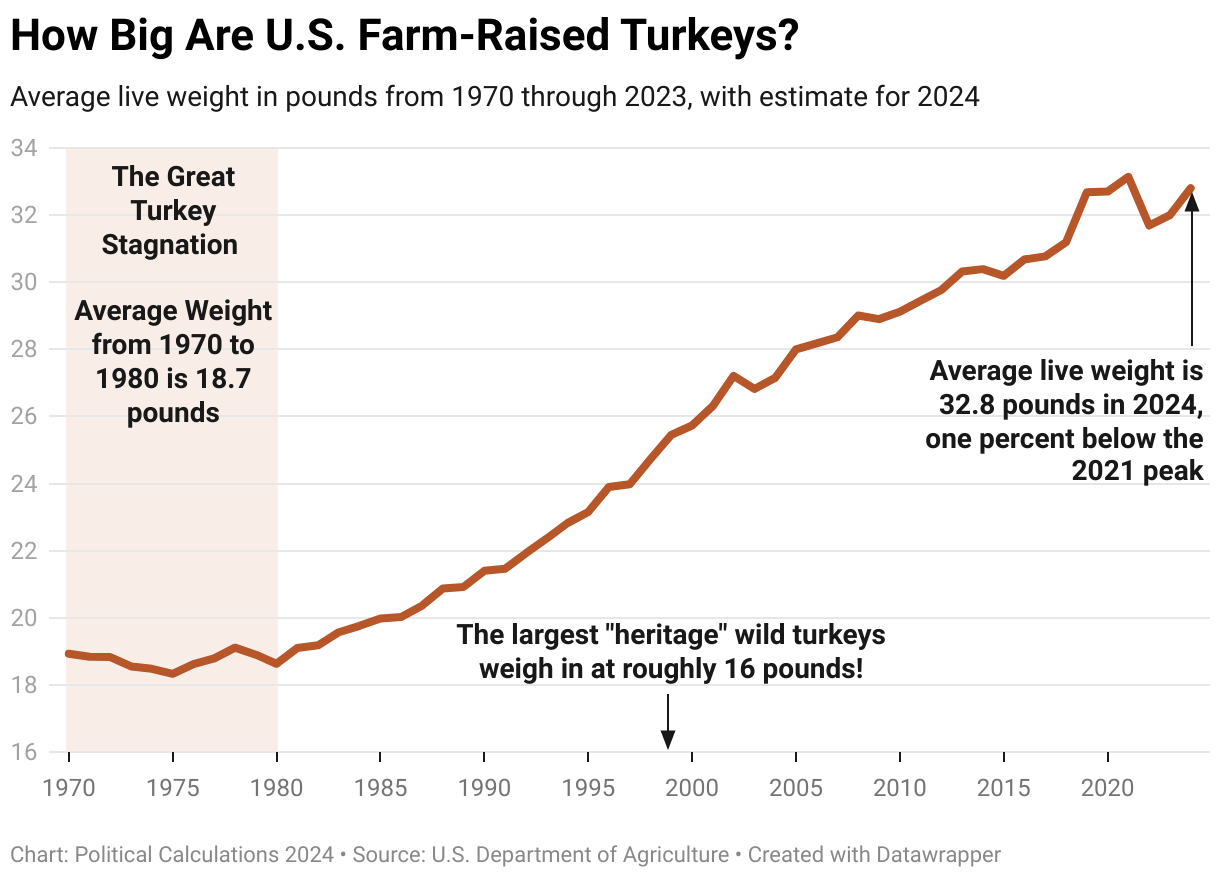
At more than 32 pounds, farm-raised turkeys are more than double the size of wild "heritage" turkeys in the U.S. on average. Most the increase in the size of farm-raised turkeys has taken place since 1980.
References
U.S. Department of Agriculture. Turkeys Raised. [PDF Document]. 27 September 2024.
Image Credit: Microsoft Copilot Designer. Prompt: "A picture of a turkey who has been exercising and building up bulk".
Labels: data visualization, thanksgiving, turkey


Farm-raised turkeys account for about 97% of the entire population of turkeys in the United States. If you are having turkey at your 2024 Thanksgiving dinner, it almost certainly came from a farm.
Of the 205 million turkeys raised on U.S. farms during 2024, 180 million were raised in just 13 states. Which state do you suppose your Thanksgiving turkey came from?
Until "Big Turkey" starts putting that information on their packaging labels, you're simply going to have to play the odds. To make that easier, we've generated the following interactive map which identifies the top turkey-producing states of the U.S. and indicates the number of turkeys raised on farms within them.
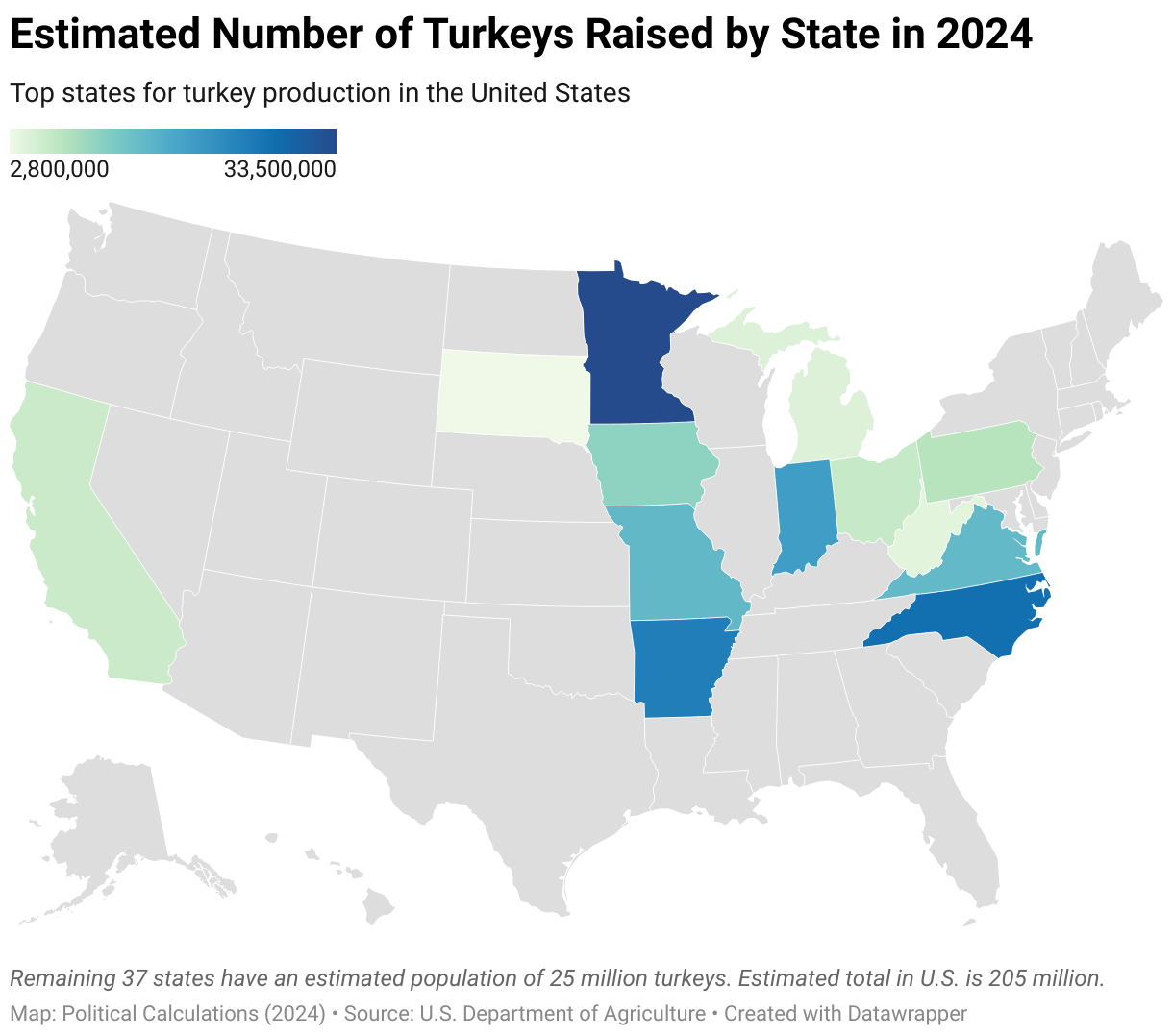
When you play the odds, you'll find there is a one-in-six probability that the turkey on your table will have come from 2024's top producer of farm-raised turkeys: Minnesota.
If you want to get odds that are more in your favor, there's a better than 50% chance your turkey will have come from one of four states: Minnesota, North Carolina, Arkansas, or Indiana. Meanwhile, the odds are a little better than one-in-three that it came from either California, Iowa, Michigan, Missouri, Ohio, Pennsylvania, South Dakota, Virginia, or West Virginia. Not to mention a one-in-eight probability it came from a turkey farm in any of the other 37 states.
References
U.S. Department of Agriculture. World Agricultural Supply and Demand Estimates (WASDE - 654). U.S. Quarterly Animal Product Production. Nov Proj. Turkey (Ready To Cook Weight, millions of pounds). [PDF Document]. 8 November 2024.
Image Credit: Microsoft Copilot Designer. Prompt: "A picture of a turkey looking at a map of the United States".
Labels: data visualization, thanksgiving, turkey

It's Thanksgiving week! We're marking the occasion by taking on questions that may come up during family celebrations of the holiday. And while many of these questions might be asked by children, they're important enough that the U.S. Department of Agriculture's National Agricultural Statistics Service and the U.S. Fish and Wildlife Service keeps track of them.
Let's start with a very basic question: How many turkeys are there in the United States?
The answer to that question comes in two parts, because there are two distinct portions of the population of turkeys in the U.S. There are farm-raised turkeys, which are mainly raised in 13 states, and there are wild turkeys, who live throughout most of the continental U.S.
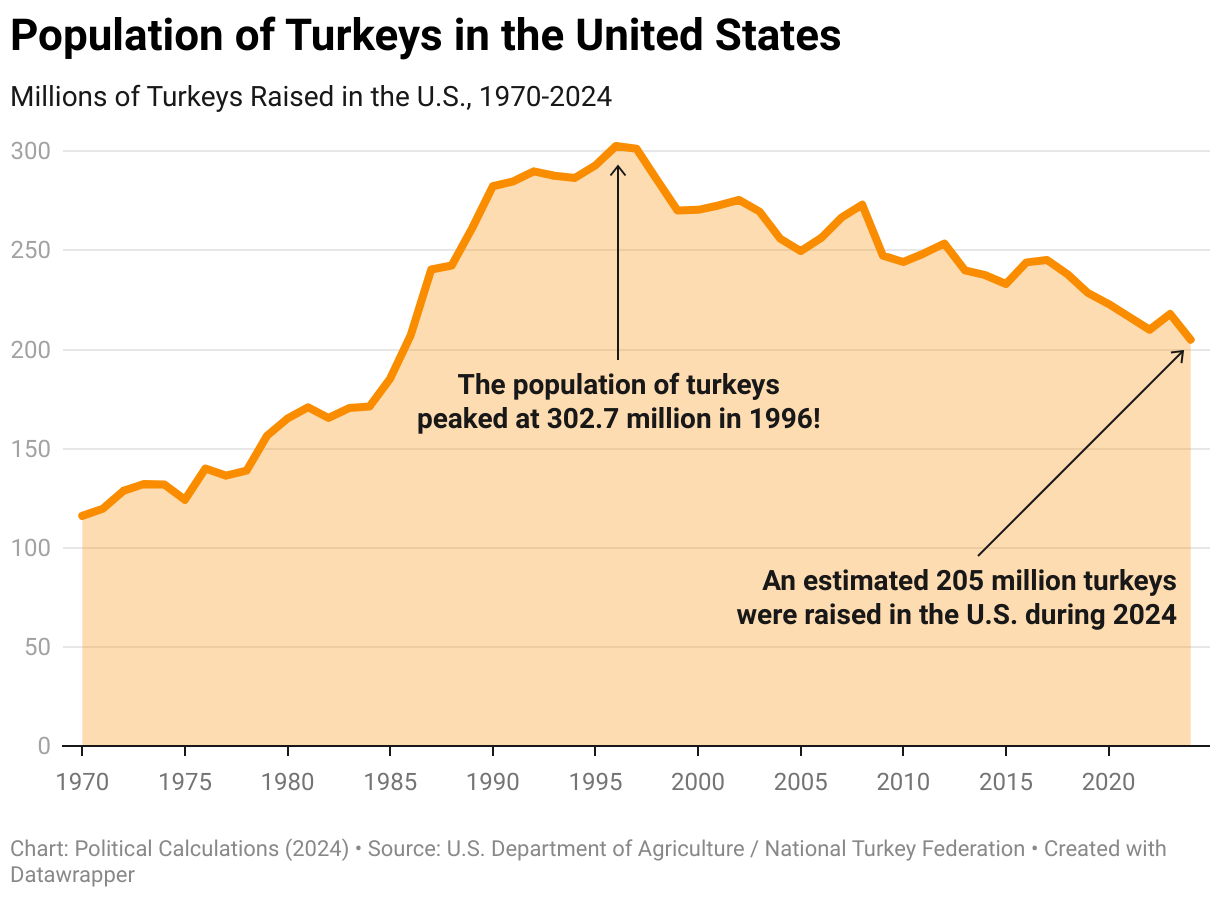
We'll start with the population of farm-raised turkeys, because their numbers are so much larger than the population of wild turkeys. In 2024, an estimates 205 million turkeys have been raised on U.S. farms. That number is down from 2023's estimated 219 million farm-raised turkeys and is well below the record number of 302.7 million turkeys that were raised on U.S. farms in 1996.
The following interactive chart presents the number of farm-raised turkeys for each year from 1970 through 2024:
It's harder to count the population of wild turkeys in the U.S. because their numbers have to be inferred from data collected by hunters and conservationists, where for every wild turkey they see, there are many more they did not see. The U.S. Fish and Wildlife Service reports there are an estimated 6.5 million wild turkeys in the U.S.
That puts the total population of turkeys in the U.S. at 211.5 million in 2024. Since about 97% of these turkeys were raised on farms, those birds are the ones you'll most often find at the center of a traditional Thanksgiving dinner.
References
U.S. Department of Agriculture National Agricultural Statistics Service. Livestock Historic Data. [Online Database: Survey - Animals & Products - Poultry - Turkeys - Production - Turkeys Production Measured in Head - Total - National - US Total - 1929-2024 - Annual - Year]. Accessed 14 November 2024.
Susan Morse. U.S. Fish and Wildlife Service. Wild Facts About Turkeys. [Online article]. Accessed 24 November 2024.
Image credit: Turkeys being raised on a turkey farm by Scott Bauer for the U.S. Department of Agriculture (3 February 2013) on Flickr. Creative Commons CC by-SA 2.0 Attribution-Sharealike 2.0 Generic Deed.
Labels: food, thanksgiving, turkey

In 2022, American poultry farmers were in crisis.
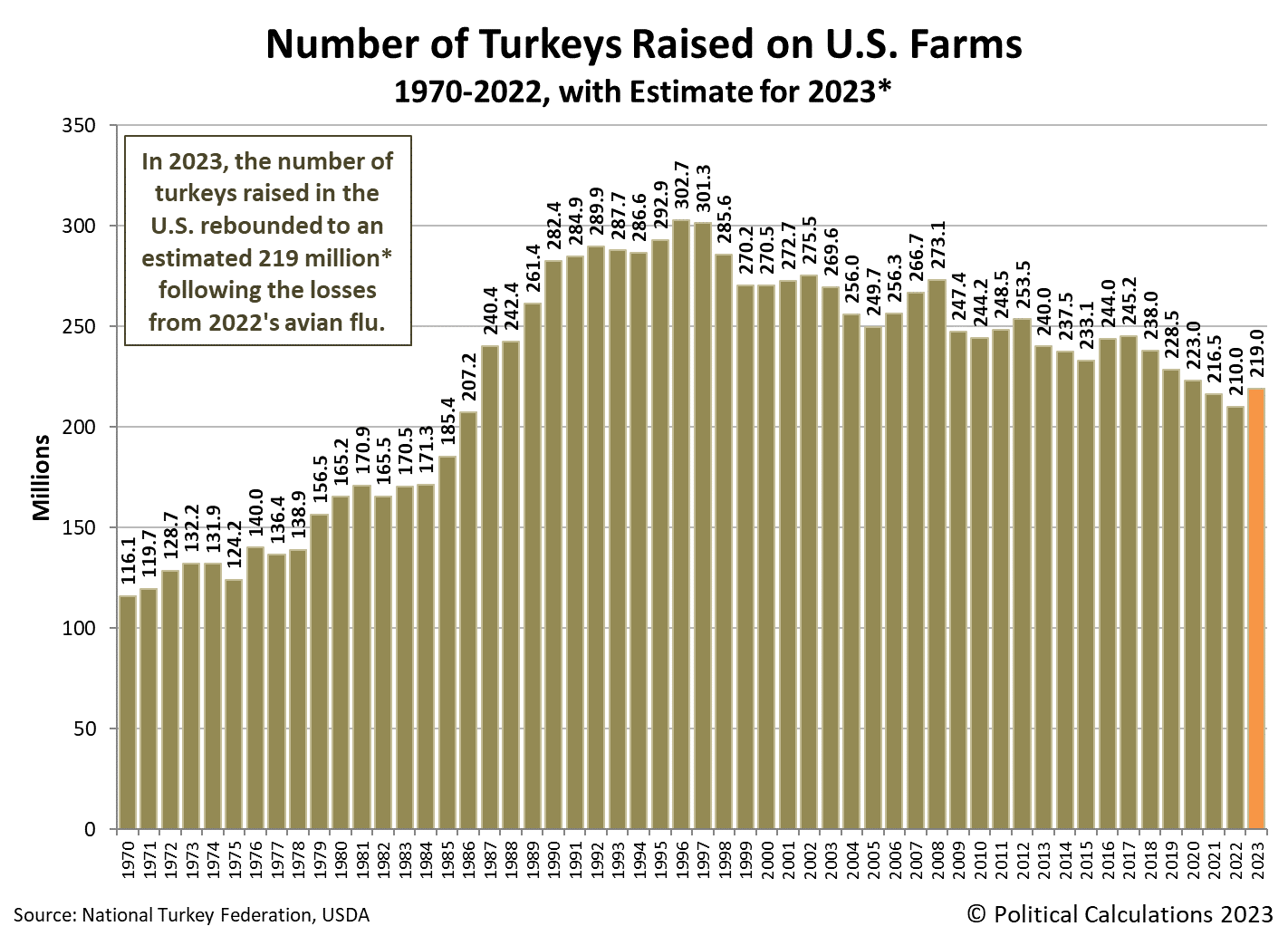
Thanks to outbreaks of Highly Pathogenic Avian Influenza (HPAI), entire flocks of chickens and turkeys on U.S. farms had to be culled to limit the spread of the highly infectious and deadly virus in early 2022. Before its spread abated, HPAI claimed the lives of approximately 36 million chickens, turkeys, and other game birds raised on U.S. farms. Among U.S. turkey producers, the population of turkeys plummeted from 216.5 million in 2021 to 210 million in 2022.
But in 2023, the domesticated turkey population rebounded to an estimated 219 million. That puts the number of turkeys raised in the United States back up the the level it was between 2020 and 2021.
That's also the third-lowest figure recorded since 1987, when the low-fat diet craze of the 1980s prompted a surge of demand for turkey among American consumers. It is also generally in line with the downward trend that has been in place since 1996, when the population of farm-raised turkeys peaked at 302.7 million.
The U.S. Department of Agriculture estimates the average weight of a live turkeys being raised on U.S. farms in 2023 is 32.0 pounds (14.5 kg). That figure is up from the 31.7 pounds (14.4 kg) recorded in 2022, but falls a little over three percent below the record average live weight of 33.1 pounds (15.0 kg) set in 2021.
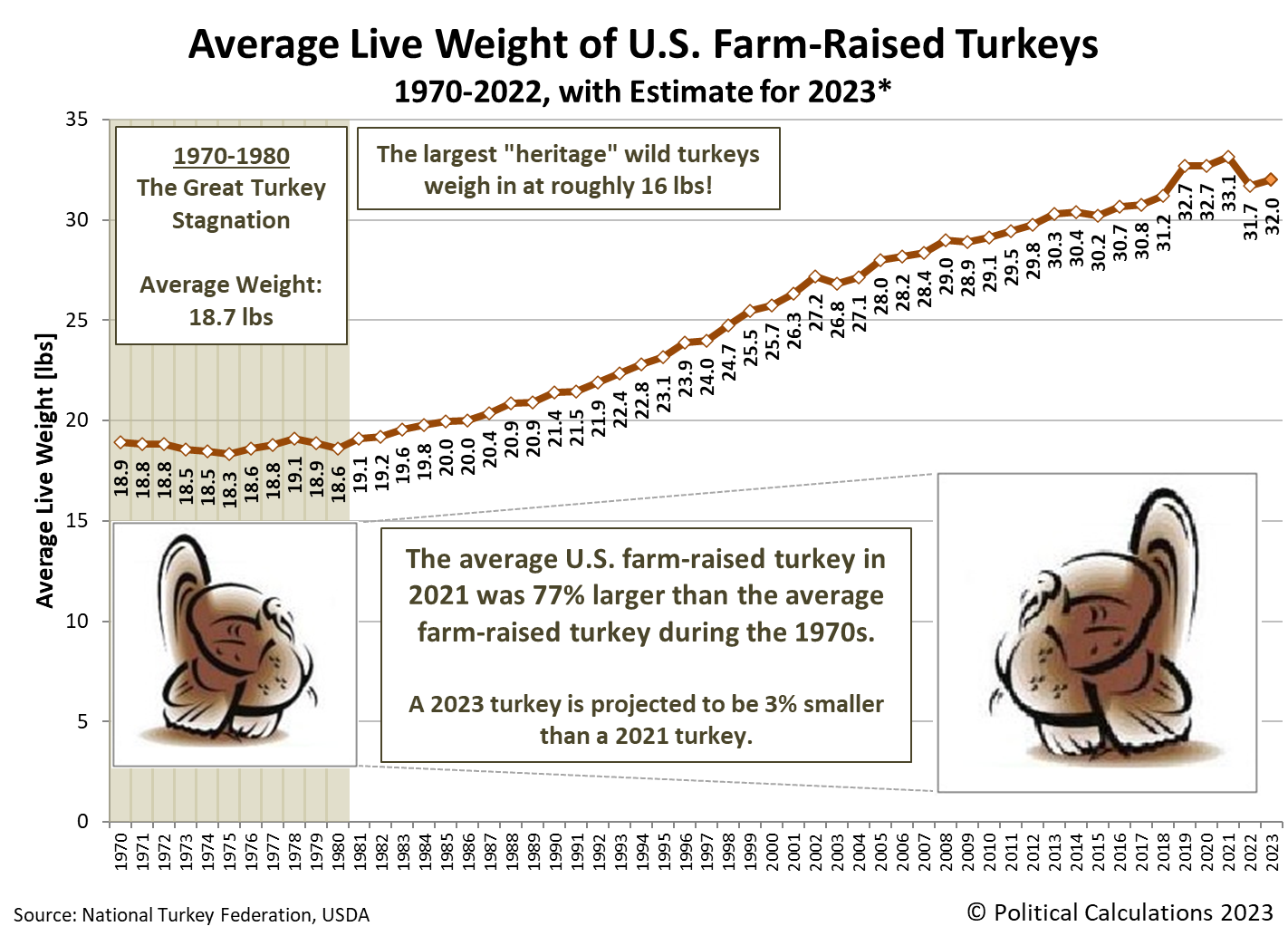
Assuming that average live weight estimate holds, the combined live weight of all turkeys raised in the U.S. during 2023 will total a little over 7 billion pounds (3.175 billion kg). That 5.3% increase from 2022's figure would be the fourth lowest annual total of the period since 1996, when U.S. turkey production first exceeded the 7.0 billion pound threshold.

The American Farm Bureau Federation puts the price of a 16-pound (7.26 kg) ready-to-cook turkey at $27.35 in 2023, which is down 5.6% from 2022's cost of $28.96. That figure however is over 41% more expensive than the $19.39 American consumers paid for the same size turkey in 2020.
Stay tuned for our next entry, when we'll look at the changing cost of a traditional Thanksgiving dinner since 2020.
References
U.S. Department of Agriculture. Turkeys Raised. [PDF Document]. 27 September 2023.
U.S. Department of Agriculture. Meat statistics tables, recent. Table 3 - Livestock and poultry live and dressed weights. [Excel Spreadsheet]. 27 October 2023.
U.S. Department of Agriculture. Poultry - Production and Value. 2022 Summary. [PDF Document]. April 2023.
U.S. Department of Agriculture. World Agricultural Supply and Demand Estimates (WASDE - 642). U.S. Quarterly Animal Product Production. Nov Proj. Turkey (Ready To Cook Weight, millions of pounds). [PDF Document]. 9 November 2023.
Image credit: Microsoft Bing Image Creator. Prompt: "farm turkeys, photograph, highly detailed, photorealistic, 4k, digital art concept".
Labels: food, thanksgiving, turkey
Having covered the inflating cost of a Thanksgiving turkey in 2022, we're turning our attention to something very different: the shrinking size of U.S. farm-raised turkeys in 2022.
That became a cause of concern for American consumers after the U.S. government warned that big turkeys would be scarce in 2022. Here's Axios' executive summary:
The U.S. government is warning of a big shortage of big birds this Thanksgiving.
Why it matters: Because of this year's avian flu outbreaks, finding 20-pound turkeys in some regions of the country could be challenging, U.S. Secretary of Agriculture Tom Vilsack said in a call with reporters on Tuesday.
The bird flu has killed more than 8 million turkeys, according to CDC data.
What they're saying: "Some of the turkeys that are being raised right now for Thanksgiving may not have the full amount of time to get to 20 pounds," Vilsack said on the call, which was about the administration's effort to reduce meat and poultry prices in the long-term.
We've seen this show before, since avian flu was also behind 2015's turkey shortage. But Axios' article doesn't answer the direct question it raises. How much smaller are U.S. farm-raised turkeys in 2022?
To find out we started with the U.S. Department of Agriculture's estimate of the total "Ready-To-Cook" (RTC) weight of turkeys that will brought to market during 2022. That figure is 5.214 billion pounds.
Looking at the last 10 years worth of data, we determined the RTC weight of turkeys averaged 79.1% of the live weight of U.S. farm-raised turkeys. Dividing the total RTC weight by this percentage gives us an estimated total live weight for farm-raised turkeys of 6.592 billion pounds. If we broaden our analysis to look at the range of RTC-to-Live weight percentages over the last 10 years, we find it has fallen between 77.46% (2021) and 79.94% (2015). Doing the same math with these figures gives us a potential range of 6.522 to 6.731 billion pounds for the live weight estimate. The higher the percentage, the smaller the estimated live weight.
All we need to know now is the estimated population of turkeys on U.S. farms. For 2022, that preliminary estimate is 212 million turkeys. That figure is two percent below 2021's final count of 216.5 million turkeys.
We can now estimate the average live weight of a U.S. farm raised turkey. Dividing the total live weight of all turkeys by their population in 2022 tells us that figure is 31.1 pounds (with a potential range between 30.8 and 31.8 pounds based on the range of total live weights). The following chart shows how that fits with all the data reported since 1970.
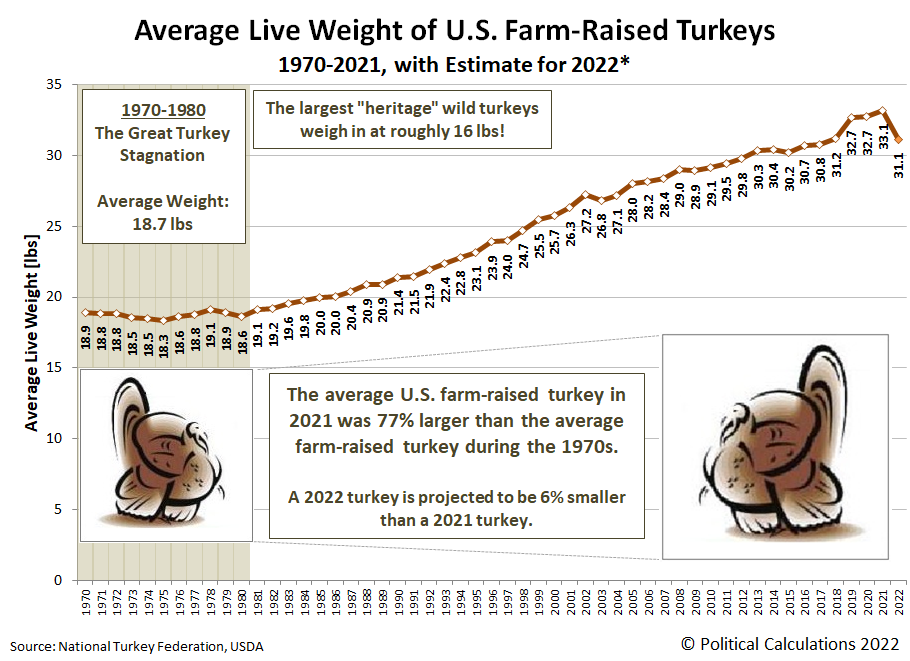
If the USDA's estimates hold, 2022 has seen the largest year-over-year reduction in the average weight of turkeys in U.S. history. Talk about turkey shrinkflation!
References
U.S. Department of Agriculture. Economic Research Service. Livestock, Dairy, and Poultry Outlook. (LDP-M-339). [Excel Spreadsheet]. 16 September 2022.
U.S. Department of Agriculture. National Agricultural Statistics Service. Turkeys Raised. [PDF Document]. 23 September 2022.
Labels: thanksgiving, turkey
The American Farm Bureau Federation reports the cost of providing a traditional Thanksgiving turkey dinner for 10 people in 2022 is 20% higher than a year ago. The identical grocery items that cost $53.31 a year ago now cost $64.05 according to the Farm Bureau's shopping survey, which is released each year just one week ahead of the Thanksgiving holiday. That new food inflation comes on top of the year-over-year 14% increase recorded last year. Over the past two years, the grocery bill for a traditional Thanksgiving dinner has risen by 36.6%.
All these changes are illustrated in the following chart, in which we've visualized the costs of all the items on the Farm Bureau's annual Thanksgiving shopping list from 2020 through 2022.
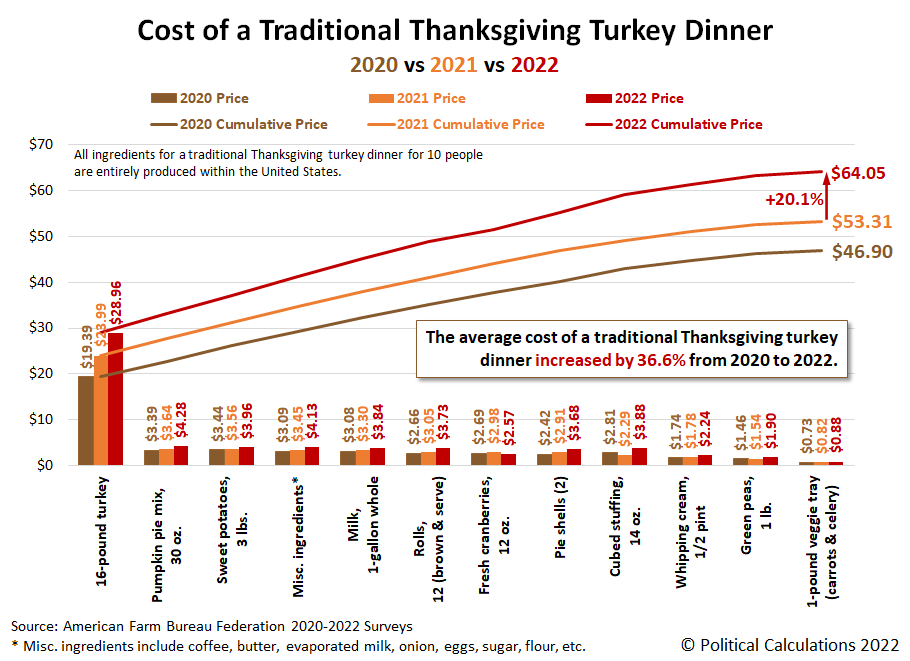
In the chart, we've ranked the cost of the individual items and groupings used by the Farm Bureau for their traditional turkey dinner menu from high to low according to their 2021 cost as you read from left to right. We've also tallied the cumulative cost of the meal, with the totals for each shown on the far right side of the chart.
Ranking the data this way lets us see that the increase in the cost of turkey is once again responsible for most of the year-over-year increase in the cost of the meal. Here we see the cost of a 16-pound bird rose by 20.7% to $28.96 in 2022. This single item alone accounts for over 46% of the year-over-year increase in the total cost for the meal. Since 2020, the cost of turkey has increased by $9.57, making up 56% of the realized increase in Thanksgiving dinner ingredient costs over that time.
Meanwhile, only the price of cranberries fell compared to last year, dropping by 13.8%. Every other Thanksgiving dinner items increased in cost during 2022.
Among those items, a 1-pound veggie tray of carrots and celery registered the smallest year-over-year price increase of 7.3%. Every other item's cost was up significantly, recording double-digit year-over-year price increases ranging from a low of 11.2% for sweet potatoes to a high of 69.4% for a 14-ounce package of cubed bread stuffing.
During the last ten years, the cost of a traditional Thanksgiving dinner held steady within a relatively narrow range between $46.90 (2020) and $50.11 (2015). Thanks to the cumulative effect of President Biden's inflation, celebrating Thanksgiving with a traditional turkey dinner has never been more costly for Americans.
Thanksgiving 2022
If you missed it, last Friday kicked off Political Calculations' annual celebration of Thanksgiving, the most American of holidays! We'll continue focusing on turkeys and the holiday through the rest of the week!
References
American Farm Bureau Federation. Farm Bureau: Survey Shows Thanksgiving Dinner Cost Up 14%. [Online Article]. 17 November 2022.
American Farm Bureau Federation. Farm Bureau: Survey Shows Thanksgiving Dinner Cost Up 14%. [Online Article]. 18 November 2021.
American Farm Bureau Federation. Thanksgiving Dinner Cost Survey: 2022 Year to Year Prices. [PDF Document]. 17 November 2022.
Labels: food, inflation, thanksgiving, turkey
For as long as we've celebrated Thanksgiving at Political Calculations, we've never once provided any information for doing the one thing most Americans' Thanksgiving dinners depend upon. Cooking a turkey.
Sure, we've featured information on how to carve a turkey. We've twice featured information on how to avoid hurting yourself and others when cooking a turkey. And we've featured the Swedish Chef cooking a turkey, although to be fair, no turkey was actually cooked during that production.
So we're going to rectify that situation today by featuring two videos that will take you through the process of cooking a turkey! But before we begin, let's just say that if your turkey is still frozen rock solid, you should skip the videos and find out what restaurants might be open near you instead....
Our first featured video will take you through the basics of what you need to know about the full process of cooking a turkey in about 12 and a half minutes. Please be aware the process in real life takes much longer....
Our second video runs a little over eight minutes and features much of the same information, but is aimed for a slightly different audience. An audience that's somewhat intimidated by not just cooking a turkey, but being judged for how well they might cook it.
Have a Happy Thanksgiving, and good luck with your turkey this year!
P.S. We're not done with cooking tips, so check back in tomorrow for an idea of what to do with your Thanksgiving dinner leftovers!
Labels: food, thanksgiving, turkey
In 2020, the average live weight of a turkey raised on a U.S. farm was nearly unchanged from 2019's final recorded average of 32.7 pounds per bird. That stagnation ended what had been a 40 year long trend of growth in the average size of turkeys produced on U.S. farms.

In the chart above, we've shown that new trend of stagnation continuing based on early signs that production factors such as the rising costs of feed, fuel, and labor for producing turkeys in the U.S. will affect the growth of the average turkey much the same as it did during the inflationary 1970s. Should the finalized data for 2021 confirm that's the case when it is released next year, it will indicate U.S. turkey producers are dealing with today's inflation similarly to how they did during that period of relative stagnation for the U.S. economy.
References
U.S. Department of Agriculture National Agricultural Statistics Service. Livestock Historic Data. [Online Database: Survey - Animals & Products - Poultry - Turkeys - Production - Turkeys Production Measured in Head - Total - National - US Total - 1929-2021 - Annual - Year]. Accessed 14 November 2021.
U.S. Department of Agriculture National Agricultural Statistics Service. Livestock Historic Data. [Online Database: Survey - Animals & Products - Poultry - Turkeys - Production - Turkeys Production Measured in LB - Total - National - US Total - 1929-2021 - Annual - Year]. Accessed 14 November 2021.
Labels: business, food, inflation, thanksgiving, turkey
An estimated 214 million turkeys were raised on U.S. farms in 2021, down 4.5% from 2020's 224 million. That decline continues an ongoing downward trend that has now lasted for 25 years.

2021 saw the fewest number of turkeys produced on U.S. farms since 1986. Turkey production had soared during the late 1980s and early 1990s thanks to that era's low-fat diet craze, which saw a sharp increase in demand for lean turkey meat.
On a side note, we now have turkey production data going back to 1929!
References
U.S. Department of Agriculture National Agricultural Statistics Service. Livestock Historic Data. [Online Database: Survey - Animals & Products - Poultry - Turkeys - Production - Turkeys Production Measured in Head - Total - National - US Total - 1929-2021 - Annual - Year]. Accessed 14 November 2021.
Labels: business, food, thanksgiving, turkey
The cost of providing a traditional Thanksgiving turkey dinner to 10 people in 2021 is 14% higher than a year ago. The same food that cost $46.90 in 2020 now costs $53.31.
That's according to the results of the American Farm Bureau Federation's annual survey of the cost of a Thanksgiving dinner were released one week before Thanksgiving 2021. In the following chart, we've visualized the Farm Bureau's year-over-year comparison of the costs of the food in their traditional Thanksgiving turkey dinner shopping list.

In the chart, we've ranked the cost of the individual items and groupings used by the Farm Bureau for their traditional turkey dinner menu from high to low according to their 2021 cost as you read from left to right. We've also tallied the cumulative cost of the meal, with the totals for each shown on the far right side of the chart.
Ranking the data this way lets us see that the increase in the cost of turkey is responsible for most of the year-over-year increase. Rising by $4.60 from 2020's $19.39 to 2021's $23.99 for a 16-pound bird, turkey alone accounts for nearly 72% of the year-over-year increase in the total cost for the meal.
Why are turkeys so much more costly in 2021? Here's a partial explanation:
Last Friday, the USDA's Turkey Market News Report showed that smaller 8- to 16-pound frozen turkeys were selling for $1.41 per pound, up from $1.15 the year before, a 22 percent increase. Large frozen turkeys were selling for a couple cents less. Meanwhile, fresh small birds were more expensive — $1.47 per pound — though the year-over-year increase was less, only 15 cents. Exacerbating the issue is that the total number of turkeys for 2021 is also down: six percent lower year-to-date in 2021 than in 2020.
Justin Benavidez, assistant professor of agricultural economics with Texas A&M's AgriLife, told the nearby KRHD News that this decreased production was the primary cause of the price increase. "This is actually one of those rare situations where the pandemic didn't have much to do with the supply and demand of turkey," he was quoted as saying.
But Gregory Martin, a poultry educator with Penn State Extension, didn't entirely agree, instead pointing to larger inflation concerns. "Prices are going to go up simply because of the cost to get the birds in the store," he told Lancaster Farming.
We'll be looking closer at American turkeys all this week!
References
American Farm Bureau Federation. Farm Bureau: Survey Shows Thanksgiving Dinner Cost Up 14%. [Online Article]. 18 November 2021.
American Farm Bureau Federation. Thanksgiving Dinner Cost Survey: 2021 Year to Year Prices. [PDF Document]. 18 November 2021.
Labels: food, inflation, thanksgiving, turkey
The United States is the largest producer of farm-raised turkeys in the world.
That's a statement that raises several questions: How many turkeys are raised on American farms? Where are these turkeys raised within the United States? If the U.S. is the world's largest producer, does it export turkeys to anywhere else in the world?
In 2019, the U.S. Department of Agriculture estimates the answer is 229 million turkeys! And as for where they are raised within America, we created an interactive map to show where farm-raised turkeys can be found within the U.S.
The answer to the third question is yes, the U.S. does export food products made from farm-raised turkeys elsewhere in the world. In the twelve months from October 2019 through September 2020, at least other 87 nations or their territories received turkey products from the U.S. The U.S. Census Bureau's estimates the value of these turkey products added up to more than $441 million.
As for where they specifically went, we created another interactive map, this time of the world, to visualize which countries imported turkey products from the U.S.
The data for the United Kingdom, France, and the Netherlands includes the value of turkey products exported to their overseas territories, many of which are in the Americas where turkeys are a native species, and which account for bulk of their indicated consumption.
Meanwhile, Mexico is the largest consumer of turkey products exported by the U.S., accounting for over $276 million (63%) of the total value of U.S. exports to the world. China was a distant second at $19.4 million (4%), as it significantly increased its imports of U.S.-produced turkey meat to help meet its 'Phase 1' trade agreement obligations and to partially compensate for its extreme shortage of pork resulting from its 2019 outbreak of African Swine Fever within its domestic hog farms.
Labels: data visualization, food, thanksgiving, trade, turkey
Thanksgiving is the quintessential American holiday, and for many American households, turkey is the centerpiece of their Thanksgiving dinner.
But how many farm-raised turkeys are there? How much turkey meat is produced each year? And how big is an average farm-raised turkey in the United States?
Political Calculations tracks all these Thanksgiving-related datapoints, tapping the U.S. Department of Agriculture's databases going back to 1970, so you can see how American farm-raised turkeys have changed over the past five decades.
Speaking of change, the population of farm-raised turkeys in the United States has generally fallen since 1996. In 2020, an estimated 222 million turkeys were raised on American farms, which is down some 27% from the peak of 302.7 million raised in 1996.

The figure for 2020 also represents a decline of 7 million from 2019's level, which itself was revised downward from an initial estimate of 240 million.
By contrast, the collective live weight of farm-raised turkeys has generally plateaued since 1996, falling within a range between 6.877 billion pounds (1999) and 7.922 billion pounds (2008). The initial estimate of the live weight of 2020's 222 million farm-raised turkeys is 7.175 billion pounds.

The combination of a generally flat total live weight for all turkeys produced on American farms with a falling number of birds can only be explained by the growing size of individual turkeys. In 2020, we estimate the average weight of a live farm-raised turkey in the U.S. is 32.3 pounds, down slightly from 2019's revised figure of 32.5 pounds.

Compared to the decade of the 1970s, when the average farm-raised turkey tipped the scale at 18.7 pounds, that represents a 73% increase in the typical size of turkeys produced in the U.S., where their average weight has steadily risen over the last four decades.
That trend may be changing however, because smaller turkeys are in high demand as Americans downsize for 2020's Thanksgiving. With celebrations limited to immediate family members with the ongoing coronavirus pandemic, American consumers have been bypassing larger birds in favor of smaller ones.
Data Sources
National Turkey Federation. Sourcebook. [PDF Document]. October 2013.
U.S. Department of Agriculture. National Agricultural Statistics Service. Poultry - Production and Value: 2019 Summary. [PDF Document]. April 2020.
U.S. Department of Agriculture. National Agricultural Statistics Service. Turkeys Raised. [Online Database]. Accessed 1 November 2020.
U.S. Department of Agriculture. Economic Research Service. Livestock, Dairy, and Poultry Outlook. (LDP-M-316). [PDF Document]. 16 October 2020.
Labels: food, thanksgiving, turkey
A three-minute classic, with The Muppet Show's Swedish Chef and his uncle, Danny Kaye, preparing a turkey for Thanksgiving....
Of course, the all-time Thanksgiving comedy classic belongs to WKRP in Cincinnati's "Turkeys Away" episode. Here's one of the two clips that everyone who has ever seen the show remembers, from a series that has largely been lost to time because of copyright laws and music licensing fees.
If you must talk about anything political this Thanksgiving, try copyright laws. Free WKRP!
Labels: thanksgiving, turkey
After answering "how big of a turkey you should get", let's tweak the question a bit and ask "how big can a turkey get?"!
Let's start answering that new question by finding out how big turkeys have already become. To find out, we've pulled 50 years of data on U.S. farm-raised turkeys from the National Turkey Federation and the U.S. Department of Agriculture, which includes finalized data from 1970 through 2018 and preliminary data from 2019.
In 2019, U.S. farms have raised an estimated population of 240 million turkeys, which if that figure holds, would be the fewest since 1987's 240.2 million.

Altogether, the live weight of all those U.S. farm-raised turkeys in 2019 totals 7.66 billion pounds, which would be an 0.8% increase over 2018's total and is 57% greater than 1987's total.

That combination of data can only mean one thing: the size of a U.S. farm-raised turkey has grown considerably over time. The following chart shows how much, where we find the average live weight of a farm-raised turkey in 2019 is 31.9 pounds, which is 70% larger than the 18.7 pounds that the average farm-raised turkey tipped the scales at back during the stagflationary days of the 1970s.

But it's also a significant increase over the 31.0 pounds the average farm-raised turkey weighed just a year ago. We think the reason for that might be attributable to an unintended consequence of the U.S.-China tariff war, where a key part of China's strategy has been to boycott purchases of U.S.-grown soybeans.
For U.S. turkey farmers, that has made higher quality soybean meal available to be fed to U.S. farm-raised turkeys at lower prices than they have been in recent years, which means that U.S. turkeys are reaching new records in how large they can grow.
As for how big a farm-raised turkey can get, we're afraid our chart doesn't provide enough information to tell, where if they were approaching a natural limit to their potential size, it would start taking on more of an S-shaped, logistic growth pattern, leveling out at a plateau with the passage of time.
But what if we assume that we're just at the halfway point for when that might happen though we don't see that in the data yet? At 31.9 pounds, 2019's average farm-raised turkey is 13.2 pounds heavier than the average farm-raised turkey of the 1970s, before U.S. turkey farmers began boosting their yield. Adding that margin onto the today's 31.9 pound average live weight suggests that another 40 years of increasing productivity could yield turkeys that regularly reach an average live weight of 45 pounds.
Is that number unreasonable? Several varieties of farm-raised turkeys, including Broad Breasted Bronze and Cornish Cross, have already produced individual birds that weighed over 50 pounds, so yes it is possible, though it would take many more years of productivity improvements in raising turkeys for U.S. farmers to achieve it.
There are crazier things afoot in the world today. Chinese hogs farmers have embarked on an effort to raise pigs that weigh as much as polar bears. That China needs to have such an effort can in part be traced in part to another unintended consequence of the U.S.-China tariff war.
Data Sources
National Turkey Federation. Sourcebook. [PDF Document]. October 2013.
U.S. Department of Agriculture. Poultry Production and Value, Final Estimates 2013-2017. [PDF Document]. June 2019.
U.S. Department of Agriculture. Turkeys Raised. [PDF Document]. 26 September 2019.
U.S. Department of Agriculture. Livestock, Dairy, and Poultry Outlook. [PDF Document]. 15 November 2019.
Labels: business, data visualization, thanksgiving, turkey
It's probably no accident that when you type just the words "how big" into the Google search engine this time of year, one of the top autofill responses it suggests for you to click is "how big of a turkey should i get".
We're here to help you answer that question, using the thought process worked out by the creative minds of Delish, who balanced the needs to feed everyone at your table with the desire to have a reasonable amount of leftovers after the big meal!
Here's how they described their problem statement:
Buying the wrong size turkey for your Thanksgiving dinner is like buying the wrong size underwear—if it's too small you feel a sense of awkward desperation, but if it's too big you feel like you're swimming in it. To avoid that, we've come up with a fool-proof equation to calculate how much turkey you'll need based on the number of people you're serving.
While they put their solution into a chart, we're going to consolidate it into a simple tool, where you just need to enter how many people you're seeking to feed at your Thanksgiving dinner. If you're accessing this article on a site that republishes our RSS news feed, please click through to our site to access a working version of the tool.
Our turkey size tool will give you the "optimal" Ready-To-Cook weight of a turkey to get to both feed your guests and have a fair amount of leftovers, the "minimum" RTC weight of a turkey that would be enough to feed your guests and have minimal leftovers, and also the "maximum" RTC weight of a turkey that will feed your guests and let you have a generous amount of leftover turkey for future meals.
The Delish staff recommends that if you need more than 20 pounds of turkey to feed your guests, rather than get a giant bird from your grocer that might overwhelm your oven, you might instead consider cooking more than one turkey. In that situation, you might consider roasting a bone-in turkey breast along with a traditional bird if you need 8 or fewer additional pounds of turkey to feed all your guests.
And if you only need 8 or fewer pounds of turkey, roasting only a bone-in turkey breast might fit the bill, unless you really like traditional stuffing!

Labels: food, thanksgiving, tool, turkey
Do you remember the effect that the epidemic of avian influenza had upon the U.S.' poultry industry in 2015?
If not, here is a brief recap of how scary things were, especially in the states where most farm-raised turkeys are produced:
Experts say the Avian Flu hits birds hard and fast.
"Sometimes the first symptom you see is dead birds," said Dr. Bill Casto of USDA Veterinary Services. "It'll sweep through a commercial house, and in two hours they can go from all healthy birds to 75% mortality."
Dr. Casto says 5.7 million birds died in Iowa alone.
By the end of summer in 2015, the outbreak of the H5N2 avian flu virus had caused an estimated loss of 50 million chickens and turkeys in the U.S., as it became the "largest animal disease outbreak in the history of North America".
It was so bad that going into November 2015, grocery stores across the nation were warning Americans that their supply of turkeys for Thanksgiving would be at risk of running out before Thanksgiving.
Fortunately, something magical happened that ensured that every American family who wanted to have a turkey for Thanksgiving 2015 would be able to have one. See if you can pick up on what that magical event was in the following passage:
The experts say if you have your heart set on turkey for Thanksgiving, talk to your grocer ahead of time.
"Just check with them," said Roy McCallister of the USDA's Homeland Security Unit. "Make sure they have in stock what you want. The quantity is somewhat reduced but it's not eliminated There's still a quantity of turkeys on the market."
But the price will be higher than usual.
"Yes, as an average, the price of turkey, chicken, even eggs has increased due to the lack of production that has been caused by Avian flu," McCallister said.
The increased price of turkeys communicated to the American consumers who still greatly demanded them just how much more scarce they had become, leading a good number to adapt to the situation by changing the menu for their Thanksgiving holiday dinner to incorporate other, less relatively costly proteins in place of the traditional turkey. At the same time, every American family that was willing to put a higher value on having that traditional turkey at the center of their Thanksgiving dinner instead of those other options could have one just by sacrificing a bit more of what's in their wallets.
The end result of that communication through price tags was sufficient to ensure that the available supply of turkeys in U.S. grocery stores would be enough to fully make it through the Thanksgiving holiday, where one savvy shopper snapped the following picture of a real Black Friday deal!

And thus, 2015 became known as "Almost The Year Without Enough Turkey for Thanksgiving". We're sure it will soon become an animated holiday classic, complete with really catchy musical numbers. Something along these lines!...
Everyone knows you're out of ideas, Hollywood. Call our agent!
Labels: economics, thanksgiving, turkey
As a holiday tradition, Thanksgiving has been around for 395 years. And though the first Thanksgiving celebration likely didn't feature turkey at the center of the dining festivities, in the years since, the idea of serving turkey as the main protein for Thanksgiving dinner has become firmly established.
So much so that 88% of Americans who responded to a survey conducted and reported by the National Turkey Federation reported eating turkey on Thanksgiving.
There may be quite some sampling bias there, seeing as we wouldn't expect the National Turkey Federation to be polling very many non-turkey eaters, but ever since Norman Rockwell immortalized a gigantic turkey being served at an American family's Thanksgiving dinner in 1943, that really is what Americans have come to anticipate being served at their Thanksgiving dinners.
And in 1943, that was quite something, because the price that U.S. turkey farmers would have received for their birds in November of that year was $0.327 per pound, which in terms of 2016 U.S. dollars, means that 1943's Thanksgiving turkey would have cost the equivalent of $4.54 per pound.

The story of turkey prices before World War 2 isn't greatly different. In equivalent 2016 U.S. dollars, turkey prices ranged between $3.00 and $4.50 per pound in the two decades from 1909 to 1929, before plummeting by an inflation-adjusted dollar a pound during the Great Depression, before rising in price during the rationing years of World War 2.
What those inflation adjusted prices tell us is that serving turkey at Thanksgiving was an expensive proposition for most American families in the years before, during and immediately after World War 2. In fact, U.S. turkey prices peaked at $0.514 per pound in December 1948, the equivalent of $5.15 per pound in 2016, before something genuinely remarkable happened.
The price of farm-raised U.S. turkeys began to fall dramatically and mostly steadily in the sixty years from 1950 through 2009, to the point where the price of turkeys ranged between $0.41 and $0.81 per pound during the first decade of the 21st century, whether adjusted for inflation to be in terms of 2016 U.S. dollars or not.
Since 2009, the prices for U.S. farm-raised turkeys has trended upward, where as of September 2016, they've clocked in at $0.88 per pound.
Still, after adjusting for inflation, that's about 22% of what they would have cost one hundred years ago! And what that change in cost over time suggests is that dramatically falling prices may be a major contributing factor to why turkey has become the centerpiece of choice for Americans celebrating Thanksgiving - especially in the years since World War 2.
Data Sources
U.S. Department of Agriculture. National Agriculture Statistics Service. Quick Stats: Survey - Animals & Products - Poultry - Turkeys - Price Received, Measured in $/LB - National - US Total - All Years - Monthly. [Online Database]. Accessed 21 November 2016.
U.S. Bureau of Labor Statistics. Consumer Price Index - All Urban Consumers. Series ID: CUUR0000SA0 - 1913-2016. [Online Database]. Accessed 21 November 2016.
U.S. Department of Commerce and Labor. Bulletin of the Bureau of Labor. Wholesale Prices. No. 87. March, 1910. No. 93. March, 1911. No. 99. March, 1912. No. 114. May, 1913. PDF Documents.
Labels: data visualization, thanksgiving, turkey
It's time once again to celebrate the most American of all holidays, Thanksgiving, which here at Political Calculations means we turn our site over to all things turkey-related during what for most Americans will be a food-filled week of festivities!
And what better way to kick off Thanksgiving Week 2016 than by focusing on what 7 in 10 Americans say must be at the center of the dining tables in order to have a truly traditional Thanksgiving dinner this Thursday, the turkey!
But that bird on this year's table will be a lot different than the ones that may have occupied the middle of American dining tables during the first 340 years of the holiday's history. It will be more than double the size!
In the United States, a male wild turkey will grow to a weight of somewhere between 14 and 17 pounds, while a female turkey will only grow to be 8 to 10 pounds.
And until the early 1960s, turkeys raised on U.S. farms weren't much bigger than that!
A lot has changed in the last 55 years. Today, the average domestic live turkey inspected by the USDA has doubled in weight in the years from 1961 to the present, rising from 15 pounds in 1961 to just over 30 pounds as of 2013, where it has held roughly steady at that level in the years since.

That's an amazing increase in the productivity of U.S. turkey producers, which is all the more remarkable in there having been so little change in the preceding 340 years! That kind of increase in the productivity of American farmers is also a big reason for why the cost of a "traditional" Thanksgiving dinner in 2016 will be lower than both last year and also 20 years ago after adjusting for inflation (HT: Mark Perry).

Without the increase in productivity, nearly all food prices would be considerably higher in real terms today, so if you're looking for something to be thankful for this week, there's something to cheer!
Data Source
U.S. Department of Agriculture. All Meat Statistics. Historical. [Excel Spreadsheet]. Updated 27 October 2016.
Previously on Political Calculations
Labels: business, food, thanksgiving, turkey
For many Americans, part of what makes the Thanksgiving holidays such an ordeal from year to year is simply finding something new and interesting to talk about with family members around the dining table.
We've decided to make that a lot easier to do this year, because we've uncovered a pretty uncanny, yet spurious correlation between the average live weight of farm-raised turkeys in the United States and the value of the MSCI World Stock Market Index since 1970!

As you can see in our carefully calibrated chart above, whenever the value of the MSCI World index has exceeded the equivalent live weight of an average farm-raised turkey in the U.S., the index went on to either stagnate or crash. And in 2014, the value of the the MSCI World Stock Market Index has once again exceeded that key threshold, which can only mean one thing.... The climate for investors has changed, and it's time to sell!
And if they try to tell you that doesn't make any real sense, you should hold firm and tell them that the correlation is really strong (the R² is 0.9616), which means that the science is settled and that they really shouldn't want to be some kind of climate change science denier.
Speaking of which, the rising live weight of U.S. farm-raised turkeys also is strongly correlated with global warming. Believe it or not, the correlation between atmospheric carbon dioxide and global temperatures is not very strong at all (other factors do a much more coherent job in explaining actual temperature observations).
Say what you will about the science, but you cannot deny that by using tips like this, you can make the conversation around your Thanksgiving dinner table a lot more lively this year!
Previously on Political Calculations
References
U.S. Department of Agriculture. Turkeys Raised. [PDF Document]. 30 September 2014.
National Turkey Federation. Sourcebook. [PDF Document]. October 2013.
MSCI. World Stock Market Index Performance. [Online Database]. Accessed 20 November 2014.
Labels: none really, stock market, thanksgiving, turkey
Welcome to the blogosphere's toolchest! Here, unlike other blogs dedicated to analyzing current events, we create easy-to-use, simple tools to do the math related to them so you can get in on the action too! If you would like to learn more about these tools, or if you would like to contribute ideas to develop for this blog, please e-mail us at:
ironman at politicalcalculations
Thanks in advance!
Closing values for previous trading day.
This site is primarily powered by:

CSS Validation

RSS Site Feed

JavaScript
The tools on this site are built using JavaScript. If you would like to learn more, one of the best free resources on the web is available at W3Schools.com.
Other Cool Resources
Blog Roll


